Luxury Hotel Tent Showdown: Pisces vs. 25–30 Year Models for Resorts
The Luxury Tent - Pisces and the longer-life luxury hotel tent models from Stars Glamping are not a good-versus-better pair. Both classes carry the same waterproof, fire, wind, snow and temperature ratings. They separate on one commercial variable: how long the asset is designed to stay in service — 10–15 years for Pisces, and 25–30 years for the Luxury Tent - Tethys, Villa, Octagon and Shell.
That single number changes how a resort developer plans capital, refurbishment cycles and exit timing. This head-to-head decision article puts the two classes side by side on published specifications, shows where the specifications are identical, and gives a step-by-step framework for matching model class to project horizon, climate exposure and replacement strategy. Stars Glamping is a Guangzhou-based manufacturer of luxury glamping tents and camp solutions, founded in 2018 and exporting to more than 40 countries and regions.
The Short Answer: Two Service-Life Classes Behind One Rating Sheet
Choose by horizon first, then by envelope. The weather ratings will not make the decision for you, because they are identical across the compared models.
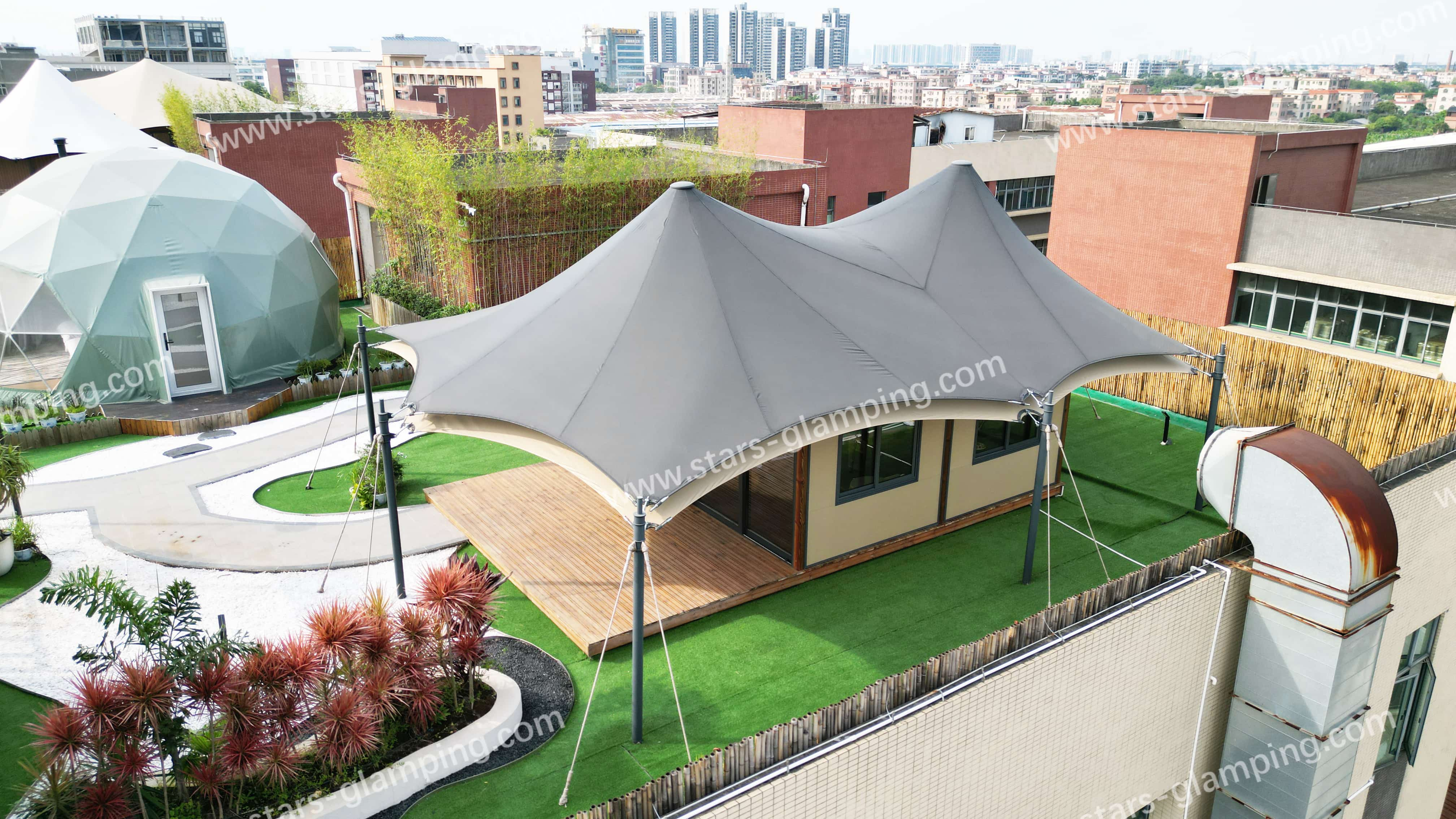
- Luxury Tent - Pisces (10–15 years): solid wood + steel pipe frame, 850 g/m² PVC polyester cover, insulated canvas wall system. A fit where the project horizon, concession or lease ends before the fabric does, or where a fabric refresh is already budgeted inside the hold period.
- Luxury Tent - Tethys, Villa, Octagon, Shell (25–30 years): steel pipe frame, 1050 g/m² PVDF architectural membrane cover, insulated glass wall system. A fit where the tent sits inside a permanent resort master plan, is financed over a long horizon, or is sited where servicing and re-fabrication are logistically expensive.
- Shared ground: every compared model is rated ≥ 5000 mm H₂O waterproofing, B1 / M2 fire-retardant, up to 120 km/h wind resistance (Level 10 wind), 80 kg/m² snow load and −30 °C to +70 °C temperature resistance.
In short: climate determines how much maintenance the asset attracts; project horizon determines which class you should buy.
Problem Definition: Why “Which Tent Lasts Longer” Is the Wrong First Question
The question “which lasts longer” almost always produces the answer “the 25–30 year model”, and that answer is technically correct but commercially incomplete. Three failure modes dominate luxury hotel tent procurement, and only one of them is about durability.
Failure mode 1: paying for life you cannot monetise
A 10-year leasehold site, a seasonal concession or a phased development with a planned refurbishment in year eight does not need a 25–30 year structure. Buying it does not create a fault; it creates capital that stays locked in the ground after the commercial window has closed.
Failure mode 2: buying life you will have to replace anyway
The reverse error is more visible on the P&L. Placing a 10–15 year model inside a 25-year master plan guarantees at least one full fabric-cycle event during the asset's life — typically landing in a peak-season year, when the unit cannot be taken offline without revenue loss.
Failure mode 3: misreading the spec sheet
Because both classes publish the same wind, snow, water, fire and temperature figures, buyers sometimes assume the shorter-life model is the weaker one on environmental performance. On published data it is not. The difference sits in material durability over time — PVC polyester at 850 g/m² versus PVDF architectural membrane at 1050 g/m² — and in the wall system, insulated canvas versus insulated glass.
Industry Background: Why Service Life Became a Line Item in the RFQ
Glamping has moved from temporary camping stock toward permanent, financeable accommodation assets, and that shift is visible in how tent ranges are now structured.
- Market scale: Grand View Research estimated the global glamping market at approximately USD 3.46 billion in 2024, with forecasts running to 2032. Fortune Business Insights publishes a higher figure for a comparable base year; the gap is generally attributed to differences in category inclusions. For planning purposes the direction of growth matters more than the decimal.
- Regional growth: Asia Pacific is projected to grow at the fastest CAGR in the sector, at 12.58% across 2025–2031, per the same Grand View Research dataset.
- Product architecture: within the Stars Glamping luxury hotel tent range, the split is by membrane, not by geometry. The five designations — Tethys, Villa, Octagon, Shell and Pisces — divide into an 850 g/m² PVC polyester group and a 1050 g/m² PVDF architectural membrane group, which is a durability split rather than a styling split.
- Compliance framing: the EU-facing documentation is a General Product Safety Directive Attestation of Conformity (CE) issued by UDEM under number M.2024.206.C96444 against EN ISO 5912:2020, valid from 31 January 2024 to 30 January 2029.
The practical consequence for a resort developer is straightforward: a luxury hotel tent quotation without a stated service-life line is incomplete, because two units with identical rating sheets can differ by a factor of two in asset life.
Detailed Solution: How Pisces and the PVDF Models Actually Differ
Luxury Tent - Pisces: the wood-and-steel, 10–15 year build
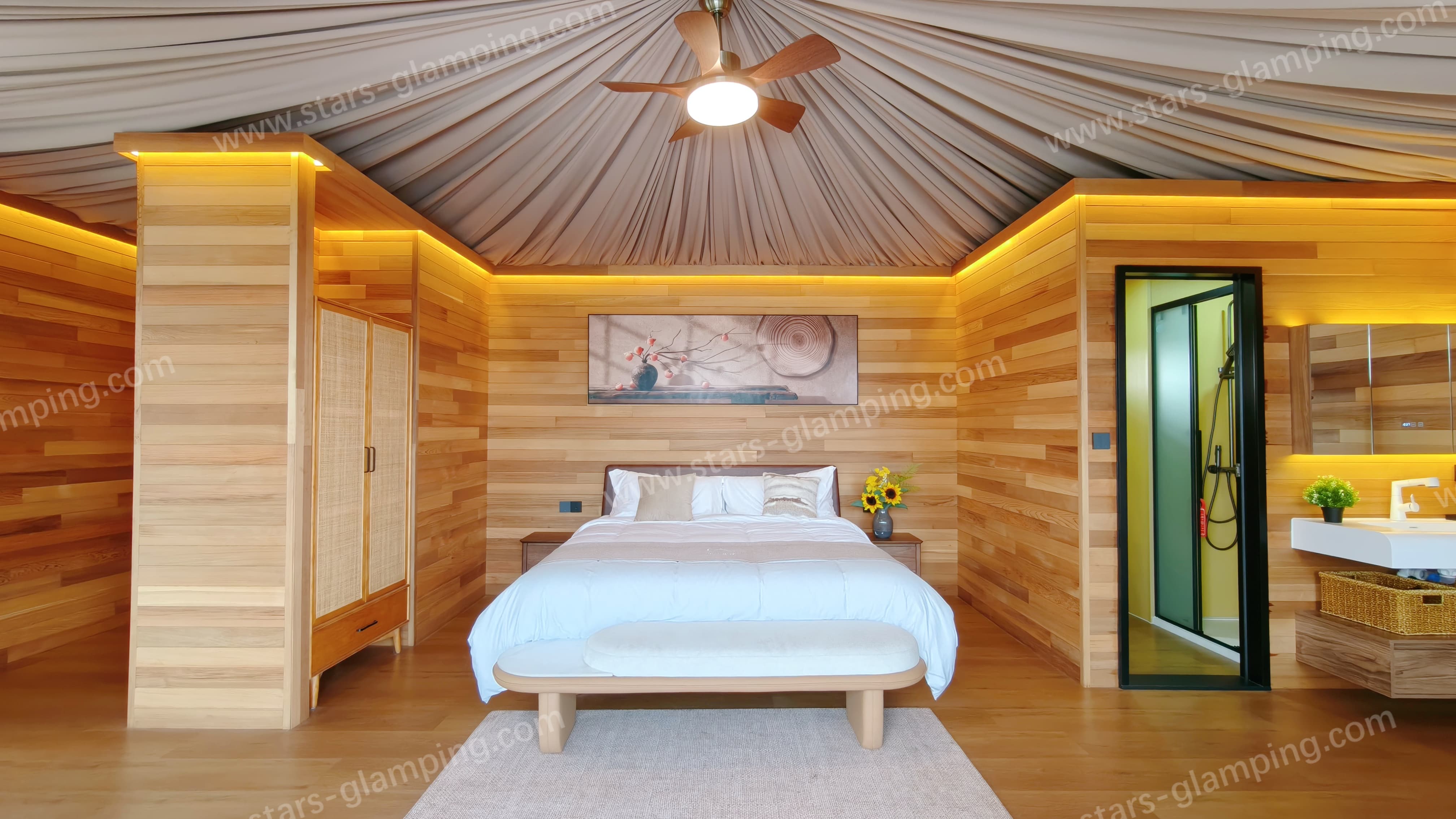
The Luxury Tent - Pisces is the only model in this comparison whose published frame specification includes solid wood alongside steel pipe. Its cover is 850 g/m² PVC polyester fabric, and the wall system is an insulated canvas construction. Published performance:
- Waterproof rating: ≥ 5000 mm H₂O
- UV protection: UV stabilized, anti-aging
- Fire rating: B1 / M2 (fire-retardant)
- Wind resistance: up to 120 km/h (Level 10 wind)
- Snow load: 80 kg/m²
- Temperature resistance: −30 °C to +70 °C
- Service life: 10–15 years
Pisces is positioned across resort accommodation, beachfront hotel tents, mountain eco-lodge tents, desert glamping tents and event use such as reception or restaurant structures. Its commercial role is therefore not “entry level” — it is the model that keeps a shorter or phased horizon from carrying a longer asset's cost.

Luxury Tent - Tethys, Villa, Octagon and Shell: the 25–30 year steel-and-PVDF build
The four longer-life models share one specification set: steel pipe frame, 1050 g/m² PVDF architectural membrane cover, insulated glass wall system, and a 25–30 year service life. Their remaining published performance figures are identical to Pisces — ≥ 5000 mm H₂O waterproofing, UV stabilized and anti-aging treatment, B1 / M2 fire rating, 120 km/h wind resistance (Level 10 wind), 80 kg/m² snow load and −30 °C to +70 °C temperature resistance.
Because the four models hold the same parameters, the choice inside the group is a layout and guest-experience decision, not a durability decision. Durability is decided at the group level, between PVC polyester and PVDF membrane.
What is identical — and why that matters commercially
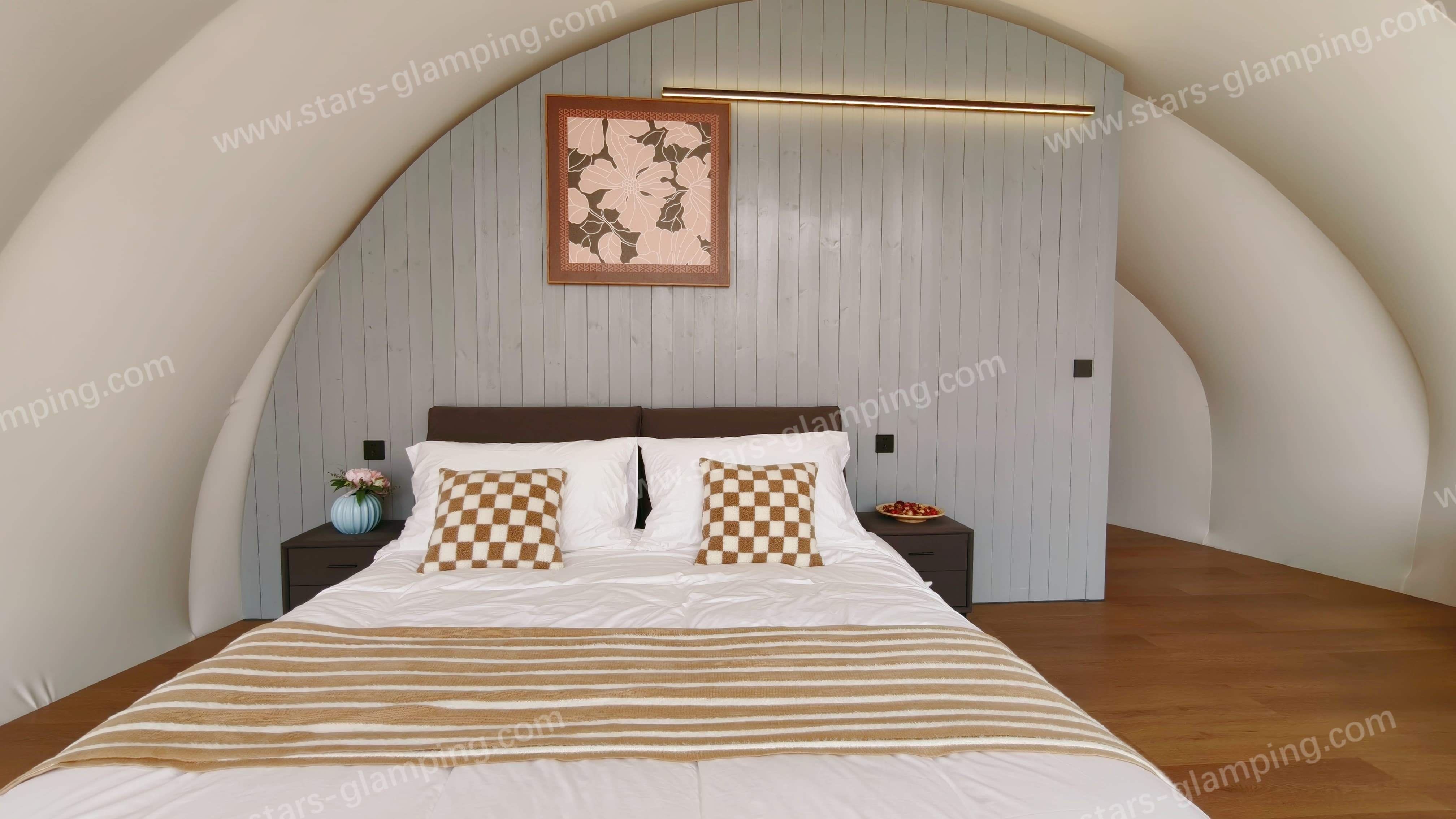
Identical ratings mean storm exposure, snow loading and temperature swings do not, on paper, favour either class. A coastal site rated for high wind and humidity, a mountain site carrying 80 kg/m² snow, or a desert site seeing wide diurnal temperature swings is addressed by the same published limits in both groups. What changes is how long the cover retains those properties, and what the guest envelope is made of: insulated canvas on Pisces versus insulated glass on the PVDF models.
Step-by-Step Breakdown: Choosing on Project Horizon, Not Guesswork
Use Cases: Matching Model Class to Resort Type
Site type influences maintenance economics more than it influences the choice of class, because the published ratings are shared. Stars Glamping project references show the range of conditions the platform is specified into:
- Beachfront and island resorts: a 100-tent beachfront resort project delivered for government tourism developers in India, specified with high wind resistance, thermal insulation, panoramic views and environmentally friendly materials. Coastal humidity makes anti-corrosion detailing and cover maintenance the dominant lifecycle cost — which favours the longer-life PVDF class where the horizon is long.
- Desert resorts: a 30-tent luxury desert resort project in Saudi Arabia, with custom desert design, high wind resistance and thermal insulation. Wide temperature swings (−30 °C to +70 °C resistance applies to both classes) and dust make envelope choice and service access the deciding practical factors.
- Mountain resorts: a 19-tent luxury mountain resort in Nepal built as a custom mountaintop design with high wind resistance, thermal insulation and panoramic views. Where 80 kg/m² snow load and steep access make re-fabrication difficult, the 25–30 year class reduces the number of interventions over the asset's life.
- Safari and eco-lodges: 12 luxury hotel tents for wildlife safari accommodation in Cape Verde, in long-term outdoor use of more than eight years, using eco-friendly materials, an off-grid solution and natural ventilation design. Eco-tourism positioning pairs naturally with a PVC polyester or PVDF cover choice driven by refresh tolerance rather than by certification alone.
Across all four references, the same logic holds: short or phased horizons with planned refreshes point to Pisces; permanent master plans on remote sites point to Tethys, Villa, Octagon or Shell.
Comparison Table: Pisces vs. the 25–30 Year Models
| Specification | Luxury Tent - Pisces | Tethys / Villa / Octagon / Shell |
|---|---|---|
| Frame material | Solid wood + steel pipe | Steel pipe |
| Cover material | 850 g/m² PVC polyester fabric | 1050 g/m² PVDF architectural membrane fabric |
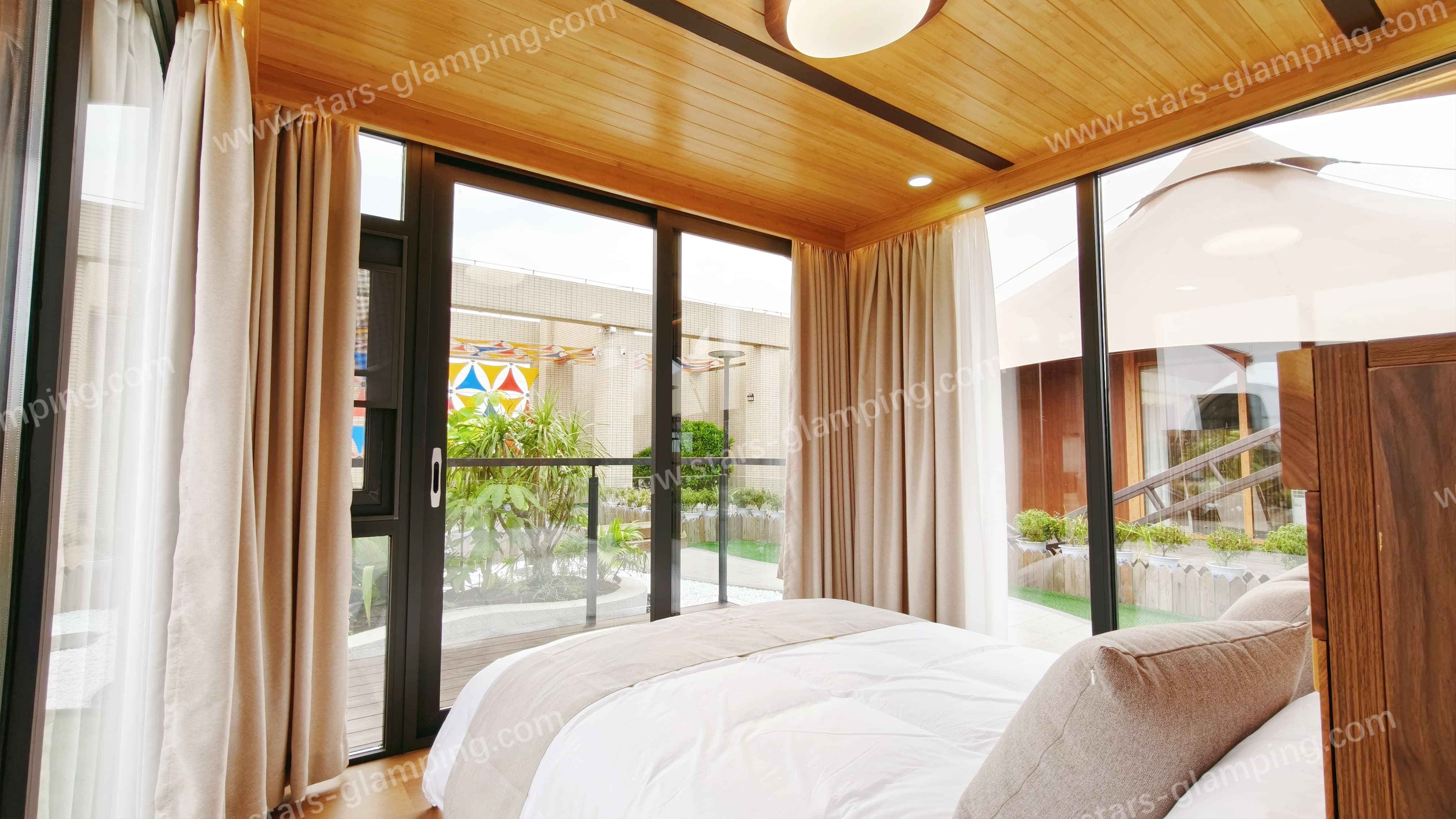
| Wall system | Insulated canvas wall system | Insulated glass wall system |
| Waterproof rating | ≥ 5000 mm H₂O | ≥ 5000 mm H₂O |
| UV protection | UV stabilized, anti-aging | UV stabilized, anti-aging |
| Fire rating | B1 / M2 (fire-retardant) | B1 / M2 (fire-retardant) |
| Wind resistance | Up to 120 km/h (Level 10 wind) | Up to 120 km/h (Level 10 wind) |
| Snow load | 80 kg/m² | 80 kg/m² |
| Temperature resistance | −30 °C to +70 °C | −30 °C to +70 °C |
| Service life | 10–15 years | 25–30 years |
| Planning signal | Lease-bound, phased or refresh-tolerant projects | Single-build, long-hold permanent assets on sites where re-fabrication is costly |
FAQ
Do these luxury hotel tents meet fire and fabric compliance requirements?
All five compared models are specified with a B1 / M2 fire-retardant rating, UV-stabilized and anti-aging covers, and a waterproof rating of ≥ 5000 mm H₂O. For the EU market, Stars Glamping holds a General Product Safety Directive Attestation of Conformity (CE) issued by UDEM under number M.2024.206.C96444 against the EN ISO 5912:2020 standard, valid from 31 January 2024 to 30 January 2029; the certificate scope covers tents and its listed related models include the Luxury Hotel Tent range. Project approval still depends on the destination jurisdiction, so fire and building requirements must be confirmed locally before contract.
Can Pisces and the PVDF models be adapted to a specific resort layout?
Yes. The customization scope covers size and layout, tent structure design, fabric material selection across PVC, PVDF and insulation, frame material, interior layout and furniture, bathroom integration, logo branding and color. Note that the published frame specifications differ between the two classes — solid wood plus steel pipe on Pisces, steel pipe on the four 25–30 year models — so frame substitutions should be confirmed against the model you select rather than assumed.
How should a resort budget compare a 10–15 year tent with a 25–30 year tent?
Compare on replacement cycles inside the hold period, not on headline unit price. Pisces is rated 10–15 years and the Tethys, Villa, Octagon and Shell are rated 25–30 years, so a 25-year horizon contains at least one full fabric-cycle event for Pisces and none for the PVDF class. Because both classes publish identical wind, snow, water, fire and temperature ratings, there is no performance differential to justify a simple price comparison. Request both quotations on identical scope — frame, cover, wall system, bathroom module, air conditioning, installation and after-sales — so the numbers are comparable.
Can we inspect a sample, showroom or factory before committing?
Yes. MOQ starts at 1 unit with samples available, and inspection is supported by a 20,000 m² manufacturing base and a 4,000 m² simulation exhibition hall in Nansha District, Guangzhou. Production runs a 12-step quality inspection system with raw material inspection, in-process quality control and pre-shipment inspection, and third-party inspection is available. The company holds 54 national patents and works with a 6-person R&D team covering architectural design, structural engineering and materials science.
What are typical lead times for a resort order?
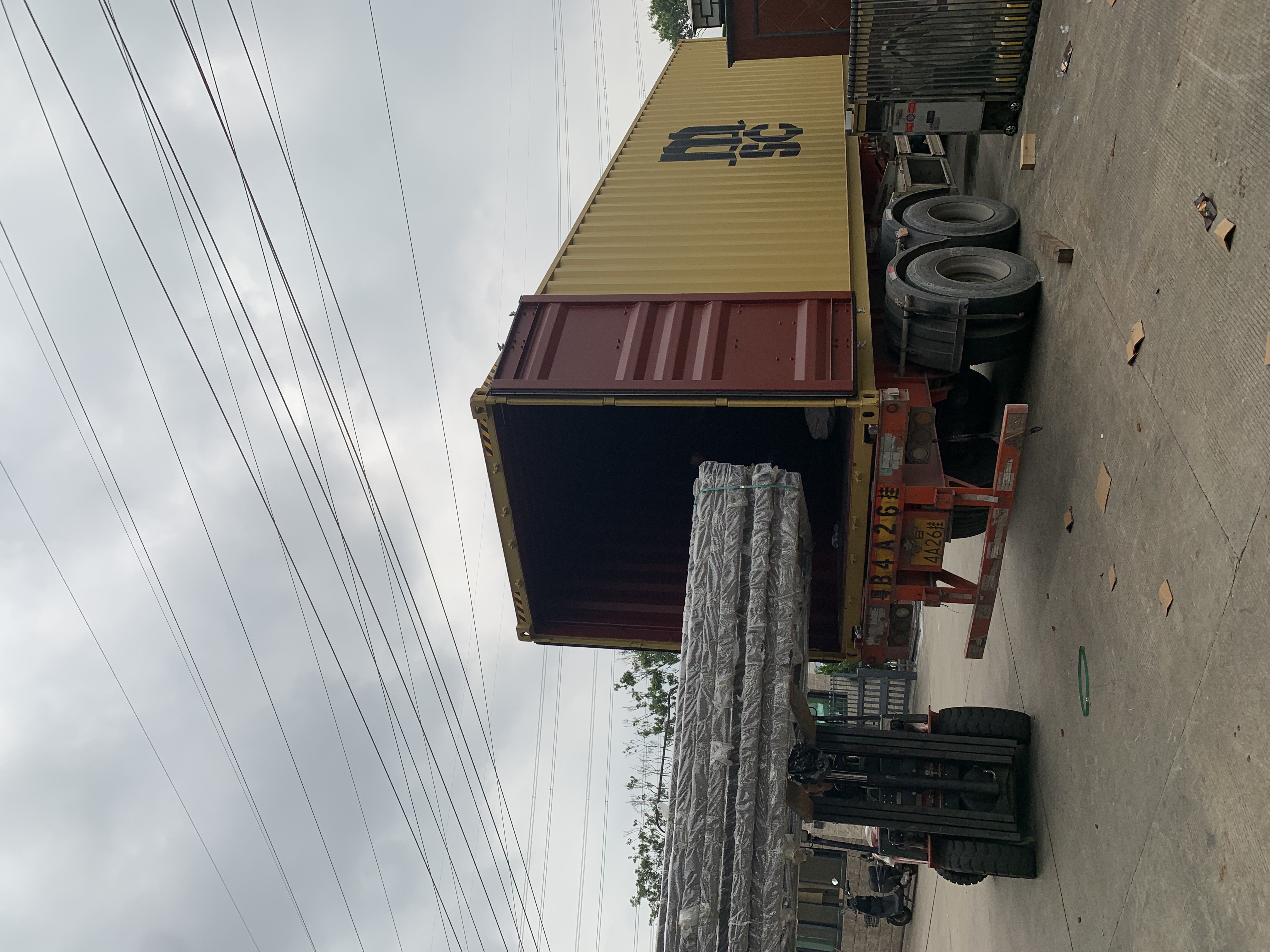
Lead time is 15–20 days for standard models and 20–30 days for customized projects, against a monthly capacity of 50–80 luxury tent units. To start a specification review, request a sample or quotation for the Pisces and PVDF classes on the same scope, or download the Stars Glamping product brochure.
Conclusion: Let the Horizon Pick the Model
The Pisces versus 25–30 year decision is not a quality argument. It is a duration argument. Both classes are rated to 120 km/h wind, 80 kg/m² snow load, ≥ 5000 mm H₂O waterproofing, B1 / M2 fire performance and −30 °C to +70 °C operation, so neither buys you a stronger building envelope on paper. What you are actually buying is the number of fabric cycles your project will absorb.
If the operating window is 10–15 years, phased, or already scheduled for a refurbishment, the Luxury Tent - Pisces — solid wood and steel pipe frame, 850 g/m² PVC polyester cover, insulated canvas wall system — matches the asset to the business case. If the tent has to sit inside a permanent master plan and outlast your financing, the Luxury Tent - Tethys, Villa, Octagon and Shell — steel pipe frame and 1050 g/m² PVDF architectural membrane — is the class that keeps the replacement event off the calendar. Stars Glamping manufactures both classes from a single facility in Guangzhou, so the comparison can be run on the same scope, the same drawings and the same quotation basis.
Next Step: Run the Comparison on Your Own Site
Send your site conditions — wind zone, snow load, temperature range, operating season and hold period — and Stars Glamping will confirm which class the specification supports before a sample is cut. Samples, quotations and project drawings are available from 1 unit upward, with 15–20 day lead times on standard models.
Website: www.starstent.com | Email: info@stars-glamping.com | WhatsApp / Tel: +86-133 2645 9475 | Brochure: Download the product catalogue
Address: Building A, No.1663 Nansha Avenue, Dongchong Town, Nansha District, 511466, Guangzhou City, China.
Have Questions or Need More Details?
Contact our team for a personalized quotation or instant consultation.
Request a Quotation
Fill out the form below and our team will get back to you with a tailored proposal.
WhatsApp Direct Chat
Prefer to chat in real-time? Message us on WhatsApp for instant assistance & quick answers.
- Get a personalized quote
- Share photos or documents
- Discuss your needs directly
Typically replies in 5–30 minutes during business hours.