
Compliance Guide: B1/M2 Fire Rating, UV & Waterproofing Standards for Luxury Hotel Tents
Compliance Guide: B1/M2 Fire Rating, UV & Waterproofing Standards for Luxury Hotel Tents
Three membrane specifications decide whether a permanent luxury hotel tent clears building approval, satisfies insurers, and is still performing in its tenth year outdoors: the B1/M2 fire-retardant rating, a waterproof rating of ≥5000 mm H₂O, and UV-stabilized, anti-aging protection of the fabric coating.
For resort developers who are still in the research stage, those three figures are usually buried in a technical annex — or missing entirely, replaced by phrases such as "100% waterproof" and "all-weather". This guide explains what each specification means, how each one is achieved through material choice between a 1050 g/m² PVDF architectural membrane and an 850 g/m² PVC polyester fabric, and how to verify all three before a purchase order is signed.
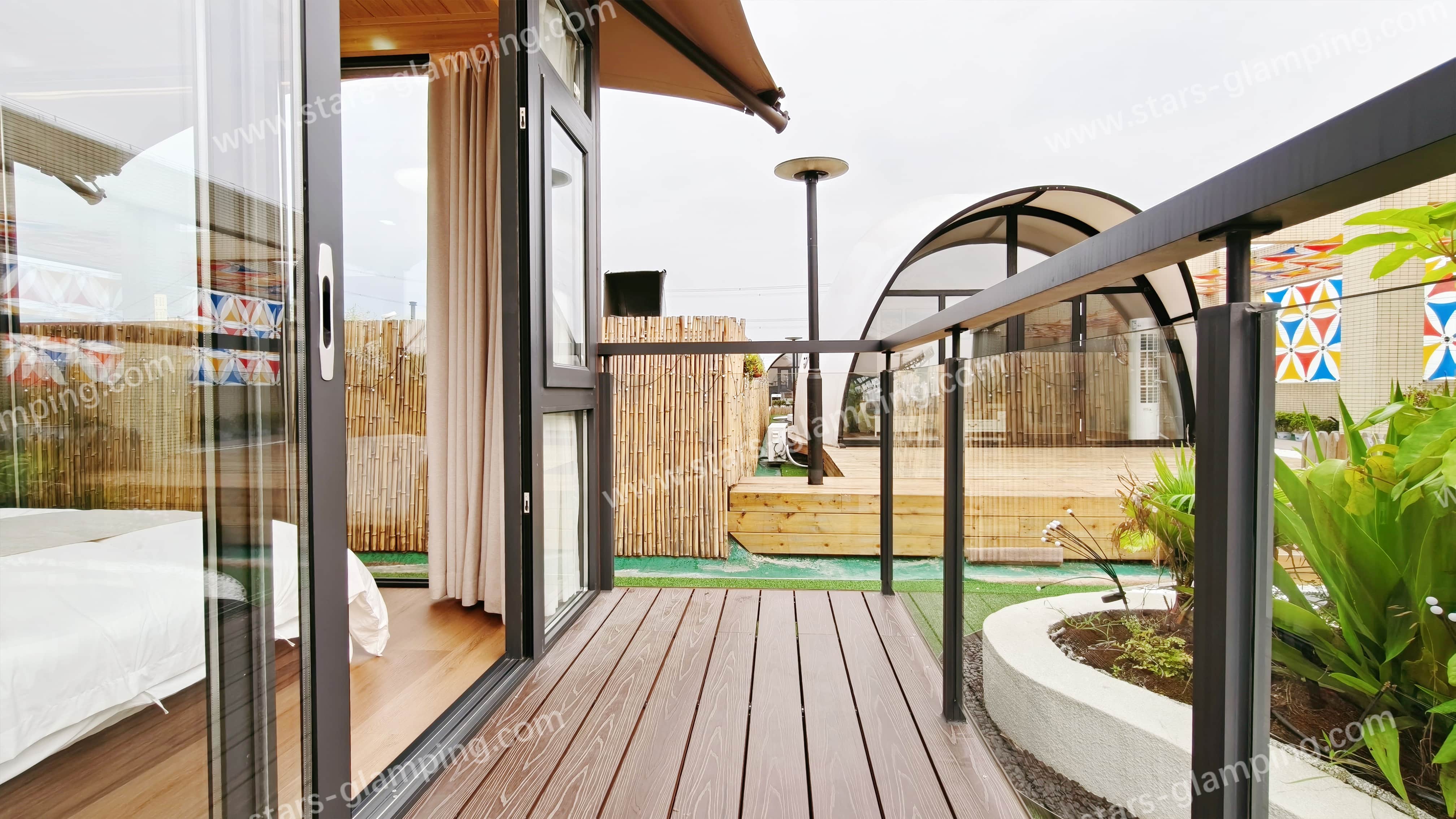
A permanent luxury hotel tent is a membrane structure: the coated fabric carries the fire, water, and UV performance of the whole building.
Stars Glamping (STARS GLAMPING TENT CO., LTD.) is a Guangzhou-based manufacturer established in 2018 that researches, designs, manufactures, and installs luxury glamping tents — including luxury hotel tents, glamping domes, and safari tents — and provides one-stop glamping solutions globally. Around 90% of its output is exported to Southeast Asia, the Middle East, Africa, Europe, North America, South America, and Australia.
Why Compliance Becomes a Purchasing Filter, Not a Legal Footnote
Most luxury hotel tent projects start with an image and end with a document pack. The distance between the two is where compliance problems appear, and they usually appear in one of three predictable ways.
- The fire certificate answers the wrong standard. A supplier may hold valid fire-retardant test data, while the authority reviewing the project expects evidence against a different framework. Buyers need to know which one applies before the drawing set is submitted, not after.
- "Waterproof" has no number attached. Without a hydrostatic head figure, two quotations cannot be compared, and the buyer cannot tell whether the cover is specified for a short alpine season or for coastal humidity and monsoon rain.
- UV protection is treated as a cosmetic issue. On desert, island, and high-altitude sites, UV exposure is continuous rather than seasonal. Anti-aging performance affects surface appearance, colour stability, and how soon the membrane must be replaced.
Each of these turns into cost: re-specification during production, a delayed opening, or a membrane replaced years earlier than the investment model assumed. The practical defence is to move fire rating, waterproof rating, and UV stabilization into the tender document before any supplier quotes.
Industry Background: Membrane Structures Are Moving From Seasonal to Permanent
Two market shifts explain why certification detail now sits at the front of the brief instead of in an appendix.
The first is scale. Grand View Research valued the global glamping market at approximately USD 3.8 billion in 2025, with tents a major accommodation segment alongside cabins and pods, and Europe holding a 35% revenue share. Fortune Business Insights projects the market to reach USD 9.15 billion by 2034, a CAGR of 10.67% over the forecast period. Growth of that order changes what developers build: permanent hotel tent structures with year-round, all-season operation rather than seasonal camps that are struck at the end of summer.
The second shift is regulatory. Once a tent becomes a permanent commercial accommodation unit, its membrane fabric is reviewed much like any other building material. International Fire Code guidance for tents, temporary special event structures, and other membrane structures references fire retardancy standards such as NFPA 701 (US) or EN 13501-1 (Europe) for safe commercial hospitality use. The supplier is therefore no longer only a fabricator; it is a source of documentation that the developer, the authority, and the insurer all rely on.
This product category — a luxury hotel tent, glamping resort tent, or permanent hotel tent structure — is used in the luxury hospitality, resort, glamping resort, and eco-tourism industry, and it is suitable for applications in the luxury hospitality and eco-tourism sector. That positioning is precisely why the paper trail matters as much as the design.
The Three Specifications, Decoded
1. B1/M2 Fire Rating: What the Letters Actually Mean
B1 and M2 are fire-performance classes for building materials, not brand names. B1 is a flame-retardant building material class under DIN 4102-1, widely referenced in German-speaking and export projects. M2 is the French classification for materials of low flammability. Together, "B1 / M2 (fire-retardant)" is the rating declared for the cover fabric across the Stars Glamping luxury hotel tent range, and fire-retardant performance stated as B1 / NFPA 701 appears in the application requirements for these hospitality installations.
The nuance a buyer should carry into the tender is this: fire-retardant classes describe behaviour under a defined test — they are not the same statement as "non-combustible". What matters at approval stage is that the test report matches the fabric weight and the coating that will actually be delivered. A report issued for one coating type does not automatically cover the other, so the document request should name the material, not just the model.
2. Waterproofing: ≥5000 mm H₂O and Why the "≥" Matters
Hydrostatic head is the water pressure a fabric resists before water passes through it. A declared rating of ≥5000 mm H₂O means the membrane is specified to withstand the pressure of a 5,000 mm column of water — a level that supports permanent hospitality use rather than occasional camping.
Both membrane options in the hotel tent range are declared at ≥5000 mm H₂O: the 1050 g/m² PVDF architectural membrane used on the Tethys, Villa, Octagon, and Shell models, and the 850 g/m² PVC polyester fabric used on the Pisces model. Industry references for heavy-duty PVC and PVDF membranes used in luxury hotel tents describe non-porous construction with hydrostatic head ratings above 10,000 mm for island and beach resort conditions. Both statements are consistent, because a minimum declaration and a higher individual test result describe the same material from two directions.
3. UV Stabilization and Anti-Aging: The Specification Desert and Island Resorts Cannot Skip
UV stabilized, anti-aging performance is declared for the cover fabric of the hotel tent range. This is the specification that determines how a waterproof luxury hotel tent looks and behaves after several years of continuous sun exposure, and it is the one most often left out of early-stage comparison sheets.
Coating type is the main variable. The 1050 g/m² PVDF architectural membrane — the PVDF membrane hotel tent configuration — is specified where long-term surface stability and a long replacement cycle matter most, with a declared service life of 25–30 years. The 850 g/m² PVC polyester fabric used on the Pisces is declared at 10–15 years and remains the more economical route to the same fire and waterproof performance. Independent industry references for high-performance PVDF architectural membranes describe service lives of 15–30 years and wind resistance up to 120–140 km/h, which points in the same direction as the specifications declared here.
4. The Envelope Around the Membrane
Fire, water, and UV ratings describe the fabric, but the approval file will also contain the structure and the systems. These are declared alongside the membrane across the hotel tent range:
- Wind resistance up to 120 km/h (Level 10 wind)
- Snow load 80 kg/m²
- Temperature resistance from -30 °C to +70 °C
- Anti-corrosion treatment for coastal environments
- Thermal insulation for all-season operation
- Custom size and modular layout available
A completed accommodation unit is matched with air conditioning, an insulation lining system, glass doors and panoramic windows, a wooden flooring system, a bathroom module with shower and toilet, an electrical and lighting system, and curtains or shading. These systems matter to compliance because every penetration — an air-conditioning line, a bathroom vent, a junction at a glass wall — is a potential water path. A modular luxury hotel tent system is only as watertight as its interfaces.
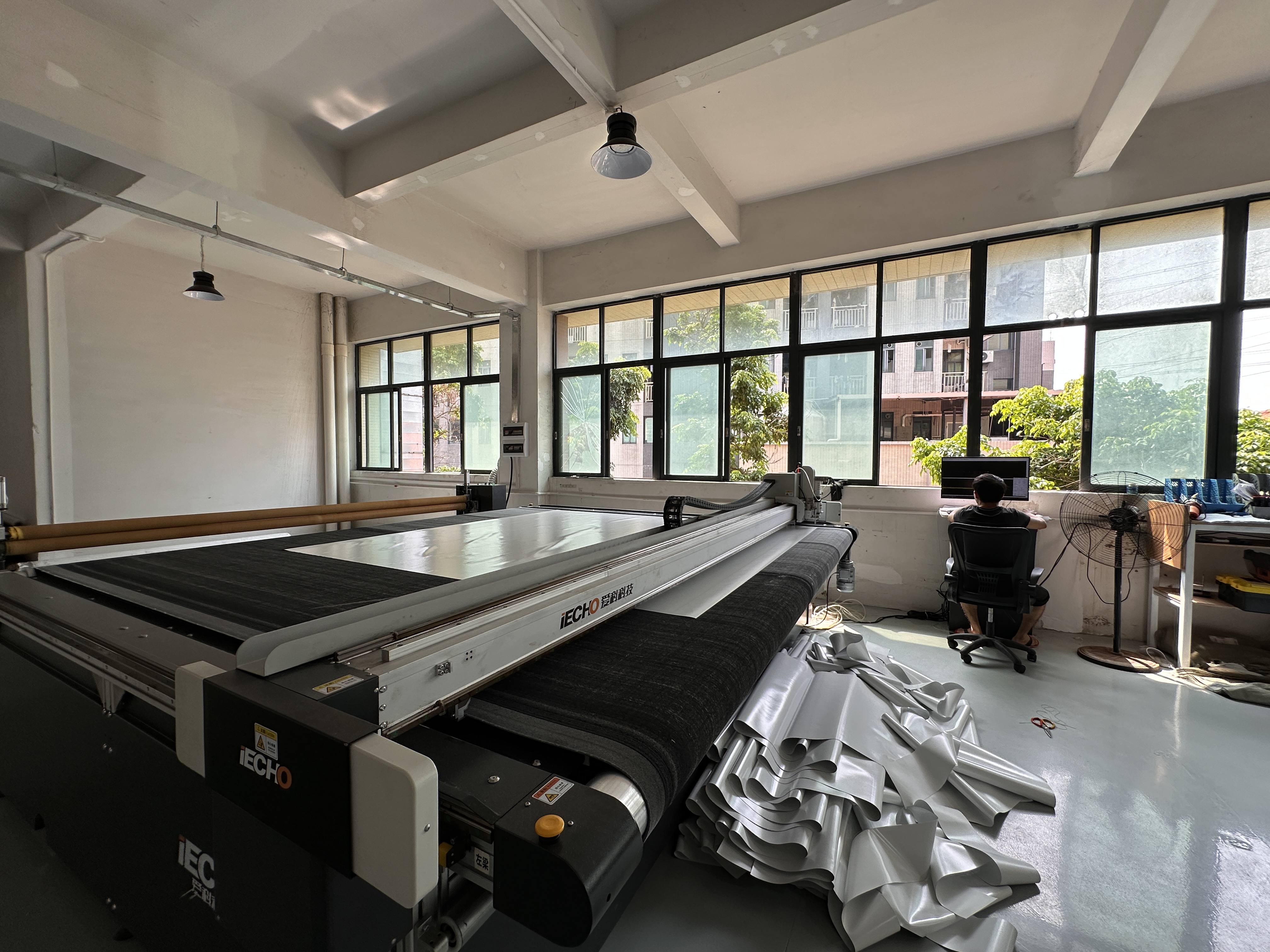
Coated membrane is cut and finished in-house, so the delivered cover can be matched to the fabric weight and coating named in the specification.
Step-by-Step: Verifying Membrane Compliance Before You Sign
The following sequence converts the three specifications into a verification process that any resort developer, procurement manager, or eco-tourism operator can run before committing to production.
- Identify the approval route first. Confirm with the local authority having jurisdiction whether the structure is reviewed as a building, as a membrane structure, or under hospitality-specific rules. This single answer determines which fire standard the file must satisfy.
- Turn the approval route into a written specification. Fire class, hydrostatic head, UV stabilization, wind speed, snow load, and temperature range. Give every supplier the same numbers so quotations become comparable.
- Request test documentation for the delivered material. The report should reference the fabric weight and coating — 1050 g/m² PVDF or 850 g/m² PVC — rather than a generic product family.
- Check the structural pack alongside the membrane. Wind resistance up to 120 km/h (Level 10 wind) and 80 kg/m² snow load are declared for the range; the calculation should reference the anchoring and foundation design for the actual site, not a generic layout.
- Match the coating to the site's UV load. Desert and island resorts justify a PVDF architectural membrane with a 25–30 year declared service life. Projects with shorter investment horizons, or with a plan to refresh the units periodically, may weigh the 850 g/m² PVC fabric at 10–15 years.
- Confirm the equipment interfaces. Air conditioning, bathroom modules, glass walls, flooring, and lighting are supplied systems. Ask how each penetration is sealed and who is responsible for that detail.
- Assemble the insurance file early. Fire performance documentation and the maintenance plan are the two items most often requested outside the construction set. Request them at quotation stage rather than at handover, when changes are expensive.
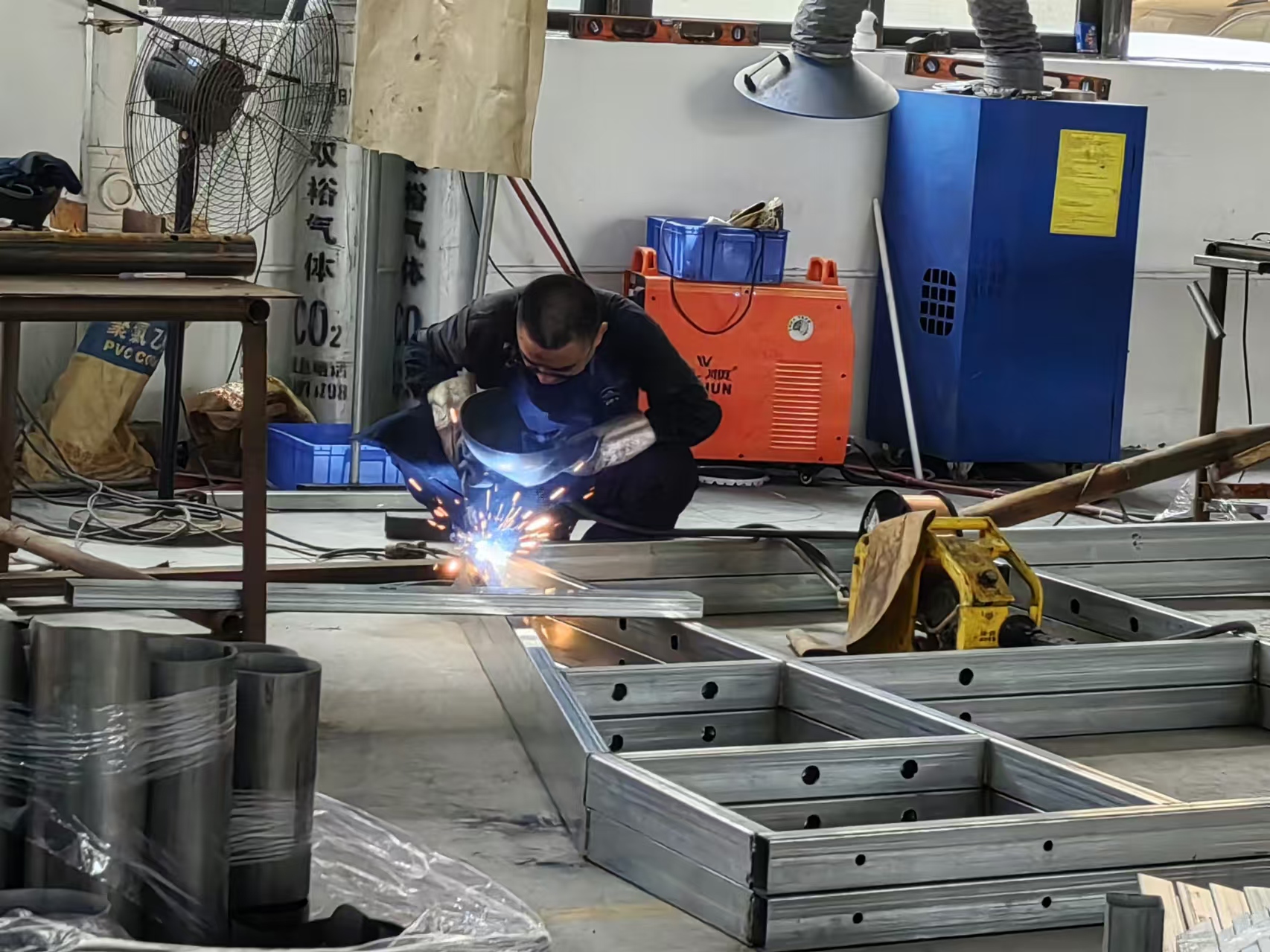
Steel frame components are fabricated in-house: wind and snow ratings depend on the frame and anchoring as much as on the membrane.
Use Cases: Which Specification Carries the Weight in Each Environment
The same three specifications apply to every project, but the environment decides which one is tested first. The table below maps common applications to the exposure that drives failure and the figure that must appear in the document pack.
| Application | Dominant exposure | Specification that must be documented |
|---|---|---|
| Luxury hotel tent for beach resort / island resort | Salt air, high humidity, horizontal rain, coastal wind | ≥5000 mm H₂O waterproof rating, anti-corrosion treatment for coastal environments, UV stabilized anti-aging fabric, wind resistance up to 120 km/h |
| Luxury hotel tent for desert resort | Continuous UV exposure, wide day–night temperature swing, dust | UV stabilized and anti-aging membrane (PVDF architectural membrane preferred), temperature resistance -30 °C to +70 °C |
| Luxury hotel tent for mountain resort / cold climate | Snow, frost, low winter temperatures | 80 kg/m² snow load, temperature resistance to -30 °C, insulation lining system, insulated glass wall system |
| Luxury hotel tent for eco tourism / safari lodge | Year-round operation, permit scrutiny, monsoon rain | B1 / M2 fire-retardant documentation, permanent installation, modular layout, ≥5000 mm H₂O waterproof rating |
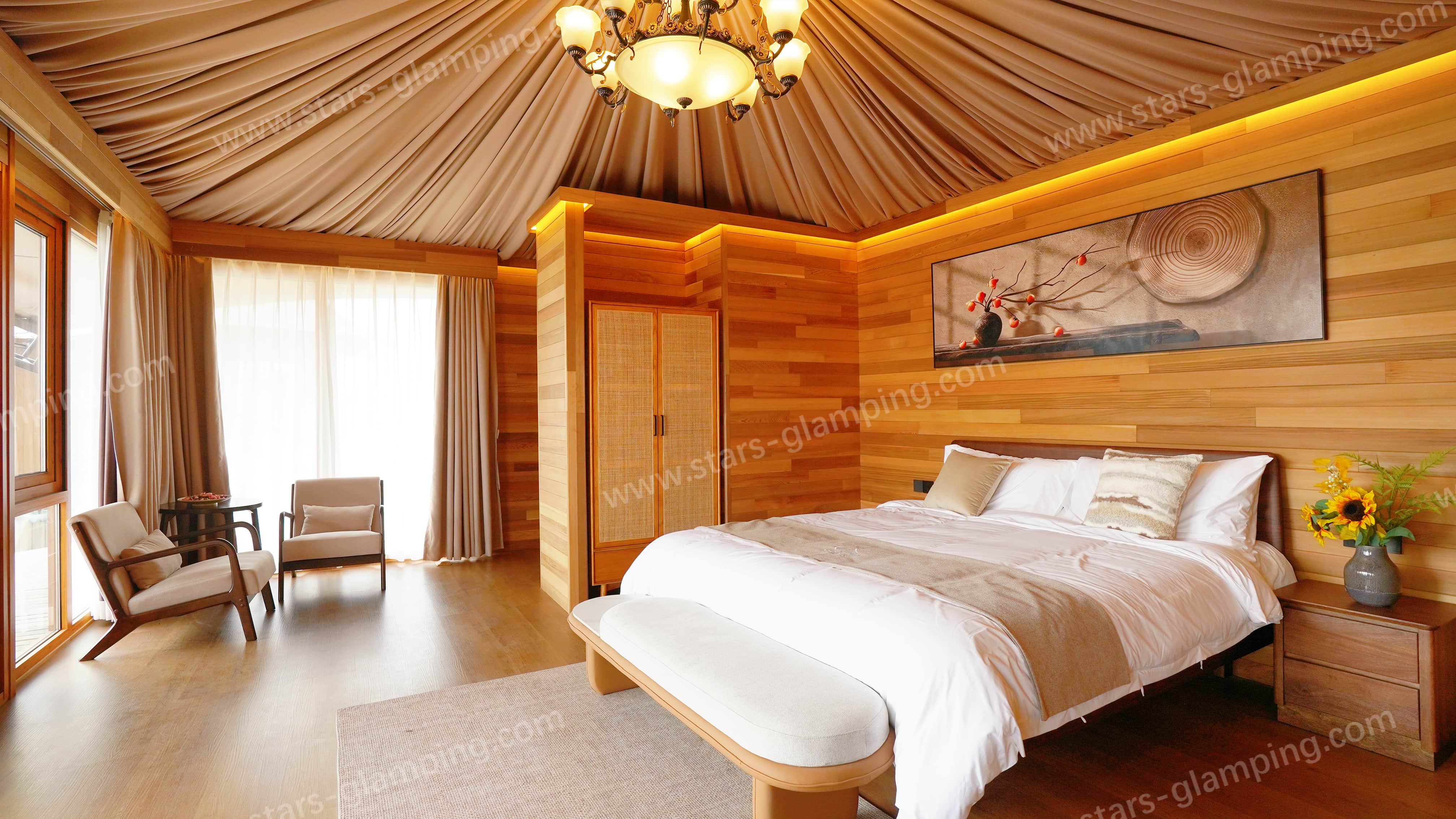
PVDF architectural membrane models are commonly specified for island, desert, and eco-resort sites where UV exposure is continuous.
Safari lodges and tropical eco-tourism projects sit between two of these categories. They face monsoon-level rain and sustained heat, which makes the ≥5000 mm H₂O hydrostatic head and the UV-stabilized coating the two figures to fix first, while the fire documentation usually becomes the binding constraint during permitting. This application scenario is common in the United Arab Emirates, Saudi Arabia, Australia, Thailand, Indonesia, Malaysia, Bhutan, Canada, Algeria, Dominican Republic, India, Kenya, Morocco, Namibia, New Zealand, Oman, Tanzania, and Vietnam.
Sustainability-oriented projects should also read the service-life figure as a material-level environmental decision. An eco friendly luxury hotel tent that stays in service for 25–30 years on a PVDF membrane needs fewer replacement cycles than a fabric replaced every 10–15 years, and sustainable hotel tent accommodation is ultimately measured by how long the structure performs rather than by a single label.
What this guide does not cover: the fire rating, waterproof rating, and UV stabilization described here do not describe acoustic performance or thermal U-values. If a project requires an insulated luxury hotel tent for cold climate with specific acoustic targets, or if soundproof luxury hotel tent behaviour is part of the brief, request separate performance data — the three specifications in this article will not answer those questions, and no supplier should suggest otherwise.
Comparison Table: Membrane and Model Specifications
Stars Glamping supplies modular luxury hotel tent systems on steel pipe frames, with PVC or PVDF coated fabric covers and insulated wall systems. The table below reflects the declared specifications for the five models in the hotel tent range.
| Model | Cover fabric | Frame | Waterproof | Fire rating | UV protection | Wind / snow / temp | Service life |
|---|---|---|---|---|---|---|---|
| Tethys | 1050 g/m² PVDF architectural membrane fabric | Steel pipe | ≥5000 mm H₂O | B1 / M2 (fire-retardant) | UV stabilized, anti-aging | Up to 120 km/h (Level 10 wind) / 80 kg/m² / -30 °C to +70 °C | 25–30 years |
| Villa | 1050 g/m² PVDF architectural membrane fabric | Steel pipe | ≥5000 mm H₂O | B1 / M2 (fire-retardant) | UV stabilized, anti-aging | Up to 120 km/h (Level 10 wind) / 80 kg/m² / -30 °C to +70 °C | 25–30 years |
| Octagon | 1050 g/m² PVDF architectural membrane fabric | Steel pipe | ≥5000 mm H₂O | B1 / M2 (fire-retardant) | UV stabilized, anti-aging | Up to 120 km/h (Level 10 wind) / 80 kg/m² / -30 °C to +70 °C | 25–30 years |
| Shell | 1050 g/m² PVDF architectural membrane fabric | Steel pipe | ≥5000 mm H₂O | B1 / M2 (fire-retardant) | UV stabilized, anti-aging | Up to 120 km/h (Level 10 wind) / 80 kg/m² / -30 °C to +70 °C | 25–30 years |
| Pisces | 850 g/m² PVC polyester fabric | Solid wood + steel pipe | ≥5000 mm H₂O | B1 / M2 (fire-retardant) | UV stabilized, anti-aging | Up to 120 km/h (Level 10 wind) / 80 kg/m² / -30 °C to +70 °C | 10–15 years |
Two facts explain how this specification sheet is produced rather than merely promised. Stars Glamping operates a 20,000 m² manufacturing base with a 4,000 m² simulation exhibition hall and a research and development team of 6 engineers and technicians, and it holds 54 national patents covering wind resistance, waterproofing, heat insulation, and quick assembly. Production runs through a 12-step quality inspection system, and annual capacity is 600–900 luxury tent units depending on project size.
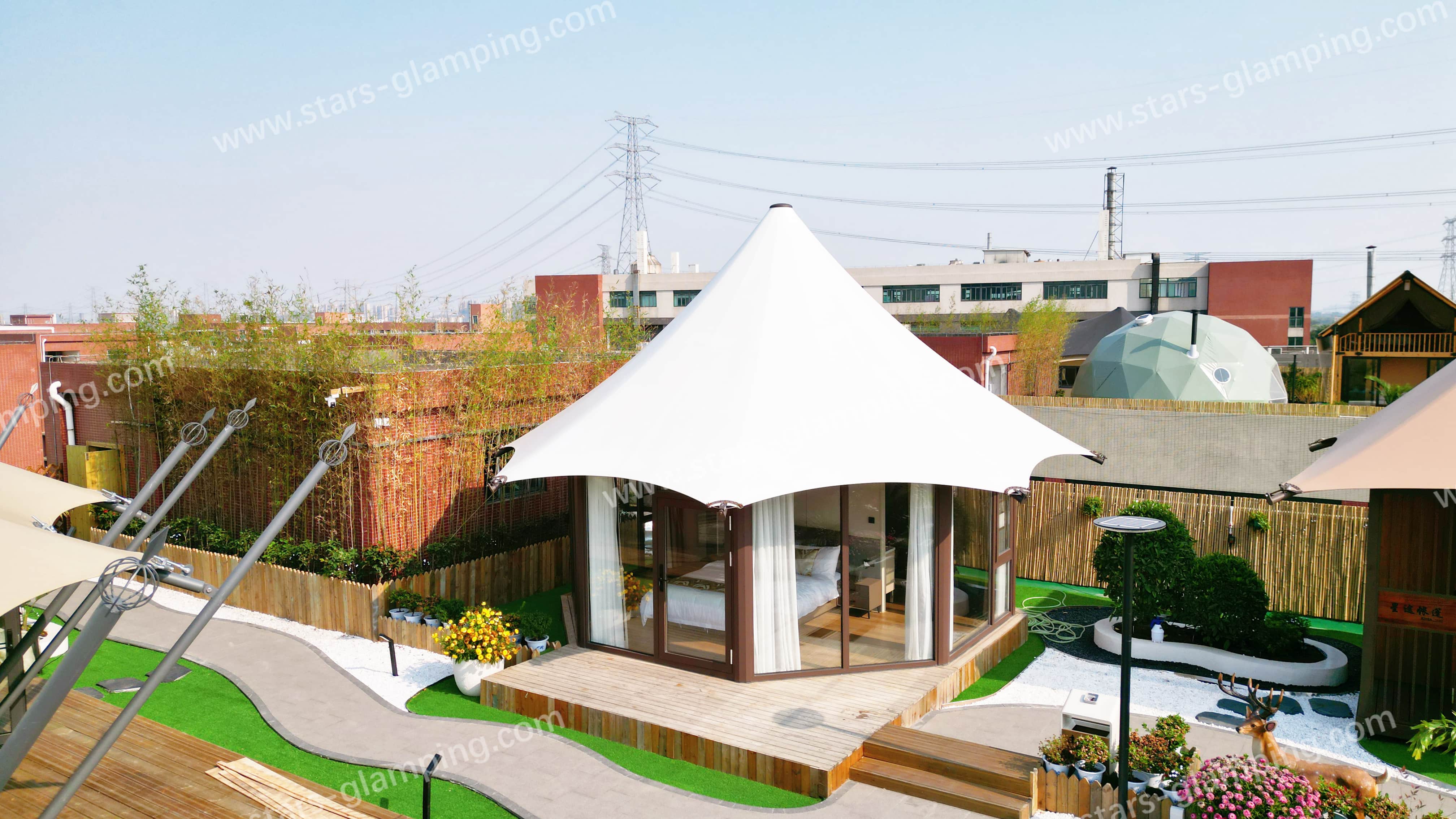
The Shell model pairs a 1050 g/m² PVDF architectural membrane with an insulated glass wall system and a declared 25–30 year service life.
FAQ: Fire Rating, Waterproofing, UV, Samples, and Lead Time
What fire rating does a luxury hotel tent need for building approval?
Stars Glamping declares a B1 / M2 fire-retardant rating for the cover fabric used across its luxury hotel tent range. B1 is a flame-retardant building material class under DIN 4102-1, and M2 is the French classification for materials of low flammability. Local authorities may instead expect evidence against other frameworks: International Fire Code guidance for membrane structures references fire retardancy standards such as NFPA 701 (US) or EN 13501-1 (Europe), and the hospitality application requirements used for these tents list fire-retardant performance as B1 / NFPA 701. Buyers should confirm which standard the authority having jurisdiction accepts, then request the matching test report for the exact fabric weight and coating being supplied.
Can a single membrane meet the fire, waterproofing, and UV specifications at the same time?
Yes. Both membrane options in the Stars Glamping hotel tent range carry the same declared performance set: a B1 / M2 fire-retardant rating, a ≥5000 mm H₂O waterproof rating, and UV stabilized, anti-aging protection. The 1050 g/m² PVDF architectural membrane is used on the Tethys, Villa, Octagon, and Shell models with a declared service life of 25–30 years, while the 850 g/m² PVC polyester fabric is used on the Pisces model with a declared service life of 10–15 years. The range also declares wind resistance up to 120 km/h (Level 10 wind), 80 kg/m² snow load, and temperature resistance from -30 °C to +70 °C, with steel pipe frames and insulated glass or insulated canvas wall systems.
How does membrane specification affect the project budget?
Specification affects the budget in two documentable ways rather than one. First, coating type changes the replacement cycle: 10–15 years for the 850 g/m² PVC fabric on the Pisces versus 25–30 years for the 1050 g/m² PVDF architectural membrane used on the Tethys, Villa, Octagon, and Shell. Second, the delivered scope changes with the equipment set — air conditioning, insulation lining, glass doors and panoramic windows, wooden flooring, a bathroom module, and electrical and lighting systems all add scope to the unit. Because no pricing is published here, the practical approach is to fix the membrane grade and the model in writing first, then request quotations against that fixed specification so every bid describes the same product.
Can we review material specifications or samples before placing an order?
Buyers can begin with the downloadable Stars Glamping product brochure, which covers the hotel tent range, and then request material and specification data — fabric weight, topcoat type, fire class, and waterproof rating — through the contact channels: info@stars-glamping.com or WhatsApp and phone at +86-133 2645 9475. Because the membrane and frames are produced and fabricated in-house, the specification discussion can be tied to the actual roll and coating that will be delivered, and custom size and modular layout are available where a standard footprint does not fit the site.
What lead time should a resort developer plan for a compliant luxury hotel tent order?
Documented delivery time is 7–15 days for domestic orders and 15–30 days for overseas orders, with an annual production capacity of 600–900 luxury tent units depending on project size. Compliance work sits before production: the fire test report, the structural documentation covering wind resistance up to 120 km/h (Level 10 wind) and 80 kg/m² snow load, and the local approval route should be settled while the model and membrane grade are confirmed. Stars Glamping provides free installation guidance, lifelong technical support, and a 24-hour global after-sales response mechanism. To confirm a production slot, send the site conditions and the fire standard your authority accepts to info@stars-glamping.com.
Conclusion: Put the Three Numbers in the Tender Document
A luxury hotel tent is approved, insured, and operated on the strength of three figures: a B1 / M2 fire-retardant rating for the cover fabric, a ≥5000 mm H₂O waterproof rating, and UV stabilized, anti-aging protection. Everything else — frame geometry, glass walls, bathroom modules, air conditioning — is built on top of that specification, and none of it compensates if the membrane is underspecified for the site.
Material choice is how those numbers are delivered. A 1050 g/m² PVDF architectural membrane on the Tethys, Villa, Octagon, and Shell models carries a declared 25–30 year service life; the 850 g/m² PVC polyester fabric on the Pisces carries the same fire and waterproof performance with a declared 10–15 year service life and a wooden-and-steel frame. Matching the coating to the UV load of the site, and matching the documentation to the standard the local authority accepts, is the difference between a smooth approval and a re-specification.
Specifying a compliant luxury hotel tent?
Download the Stars Glamping product brochure, or send your project brief — site and climate, unit count, and the fire standard your authority accepts — and the team will respond with the matching model, membrane, and the documentation list for your approval file.
Download Product Brochure (PDF)
Email: info@stars-glamping.com | WhatsApp / Tel: +86-133 2645 9475
Website: www.starstent.com | Building A, No.1663 Nansha Avenue, Dongchong Town, Nansha District, Guangzhou City, China
Sources referenced in this guide: Grand View Research (glamping market size, 2025), Fortune Business Insights (glamping market projection, CAGR 10.67%), International Fire Code guidance on tents and membrane structures (NFPA 701, EN 13501-1), and published PVC/PVDF architectural membrane performance references. Product specifications are stated as declared by Stars Glamping for its luxury hotel tent range.
Have Questions or Need More Details?
Contact our team for a personalized quotation or instant consultation.
Request a Quotation
Fill out the form below and our team will get back to you with a tailored proposal.
WhatsApp Direct Chat
Prefer to chat in real-time? Message us on WhatsApp for instant assistance & quick answers.
- Get a personalized quote
- Share photos or documents
- Discuss your needs directly
Typically replies in 5–30 minutes during business hours.