
B1 Fire Retardant Standards in Safari Tents: What Resort Builders Must Verify Before Installation
Before a safari tent is bolted to its platform, the buyer should already hold three documents: a flame-retardancy test report that names the standard, a waterproofing value expressed in mm H₂O, and a product-safety certificate that matches the country where guests will sleep. In European-facing specifications, the cover material of a safari tent is most often required to carry a B1 classification under DIN 4102-1. In North America, commercially used tents are commonly measured against CPAI-84 or NFPA 701. A brochure that says “fire retardant” without naming any of these is not verification.
Stars Glamping (STARS GLAMPING TENT CO., LTD) is a Guangzhou-based manufacturer of glamping domes, safari tents and luxury tents, founded in 2018 and operating from a 20,000 m² manufacturing base in Nansha District. The company exports the majority of its output to resort, lodge and eco-camp projects across more than 40 countries, and its product range is documented for project buyers through www.starstent.com. This guide sets out the compliance checks a resort builder should complete before installation day: what to request, how to read it, and where the documentation chain normally breaks.

Safari tent structures displayed in the 4,000 m² simulation exhibition hall at the Stars Glamping base in Nansha District, Guangzhou.
Why a “B1” Claim Alone Is Not Verification
A B1 classification describes how a material behaves when it is exposed to flame under a defined test method — it is a material property, not a marketing tier. Three gaps separate a genuine B1 specification from a claim printed on a quotation.
The claim-versus-report gap. Many quotations describe a cover as “flame retardant” without naming the standard, the test method or the laboratory. Without that, a fire officer, insurer or tour operator has nothing to assess. A report that names DIN 4102-1 B1, CPAI-84 or NFPA 701 can be checked by a third party; an adjective cannot.
The report-versus-batch gap. A test certificate usually applies to a specific fabric weight and coating system. If the tent delivered to site uses a lighter cover or a different coating batch, the certificate no longer describes the product. Buyers should request that the fabric weight, coating type and batch reference on the delivery documents match the tested sample.
The standard-versus-market gap. Fire requirements are set locally. A cover that satisfies a European-facing B1 specification is not automatically accepted in North America, where commercial tent use is commonly measured against CPAI-84 or NFPA 701. The correct sequence is to confirm the accepted standard with the local fire authority or insurer first, then order materials that carry evidence against that standard — not the reverse.
A fourth, quieter gap sits between the fabric and the finished structure. Flame-retardancy testing applies to the cover material, while the installed tent is a system of cover, frame, anchoring and interior fit-out. Installation details therefore belong in the same verification file as the fabric certificate.
Industry Background: Why Fire and Water Proof Are Now Commercial Decisions
Guest accommodation built from engineered fabric has moved from a niche format to a measured segment of the tourism economy, and the volume of installed structures is what drives scrutiny from regulators and insurers.
- The global glamping tents market was valued at USD 3,124.89 million in 2023 and is projected to reach USD 6,484.86 million by 2032 (Zion Market Research).
- The safari tourism market is expected to reach USD 66.9 billion by 2033, growing at a CAGR of 7.7% from 2026 (Grand View Research).
- Africa’s safari tourism market recorded an 8% increase in international arrivals in 2025, reaching 81 million travellers (UNWTO / Grand View Research).
More guest nights in fabric structures means more properties being reviewed by fire authorities, more insurers asking for material documentation, and more tour operators auditing the safety file of the camps they sell. HTNXT industry reporting has also linked certified eco-resort accommodation with up to 25% higher occupancy compared with non-certified or traditional low-end structures, which places compliance in the same conversation as revenue rather than in a separate technical annex.
At the same time, the climate range of safari tent projects has widened. A structure may be specified for a desert camp with extreme UV exposure, a riverside lodge with year-round humidity, or a mountain site where snow load and wind pressure dominate. A single waterproof or fire-retardant claim cannot cover that range; the more useful question is which parameter the operator is buying, and how it will be evidenced.
The Material Stack That Makes a Compliance Claim Verifiable
Cover fabric: the 850 g/m² PVC cover
In the Stars Glamping catalogue, the Neptune safari tent model is specified with an 850 g/m² PVC cover rated as 100% waterproof and flame retardant, mounted on a 76 mm galvanized steel frame. A coated PVC cover is the reason a single material can be quoted against both requirements: the coating carries the flame-retardant chemistry and closes the weave against water penetration, so the waterproof and fire behaviours come from the same engineered surface rather than from two unrelated treatments.
For a resort builder, the practical consequence is that the specification line must be read as a package: fabric weight, coating system and performance claims belong together. Requesting the cover weight alongside the flame-retardancy report is the simplest way to catch a substitution.
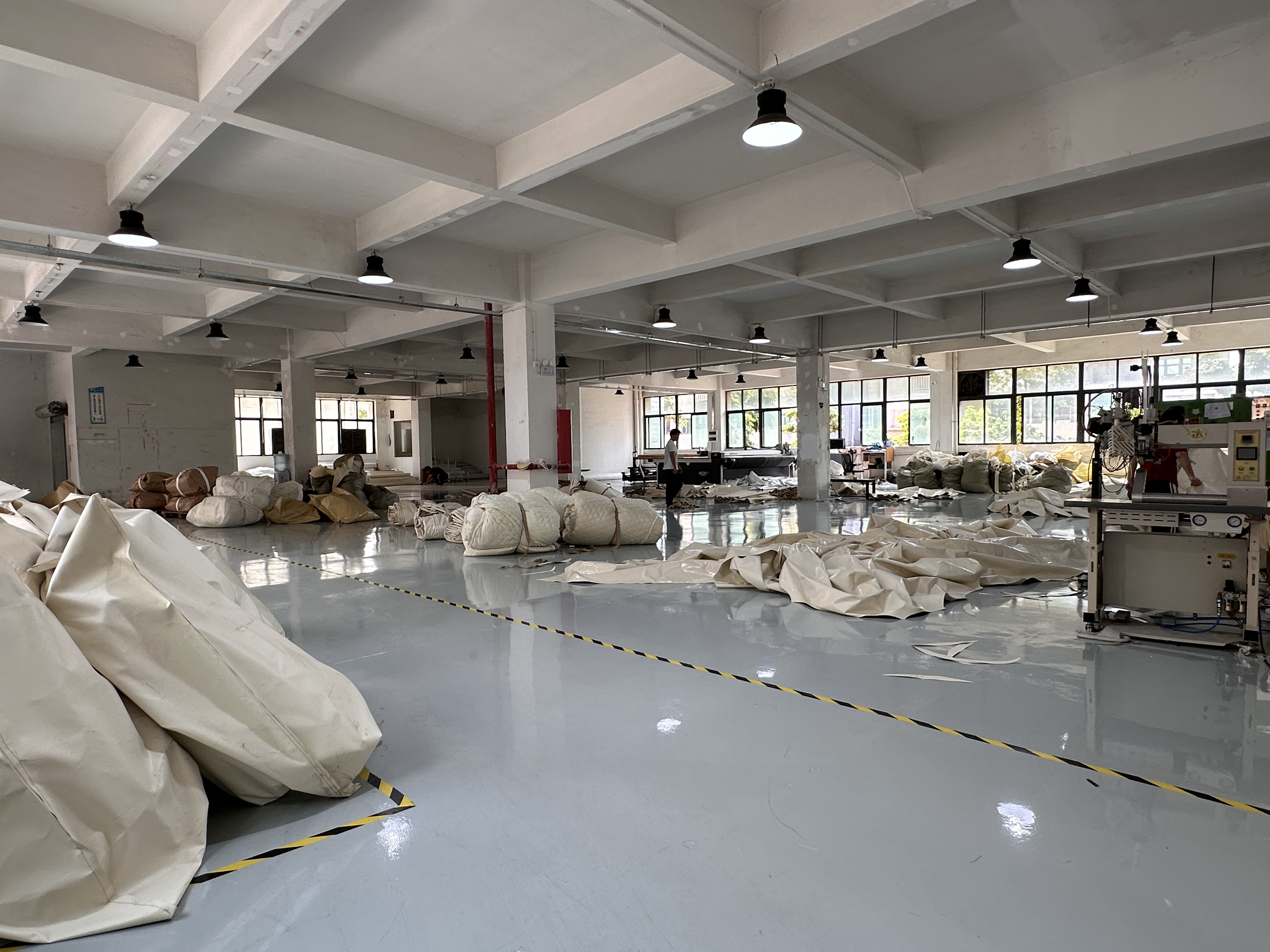
PVC cover fabric in production at the Stars Glamping fabric workshop in Nansha District, Guangzhou — the stage where the tested coating specification must stay traceable.
Frame: the 76 mm galvanized steel structure
The frame determines what happens to a fabric structure under load. The Neptune model uses a 76 mm galvanized steel frame, and the galvanized finish is what protects that frame from corrosion in humid, coastal or riverside conditions over a multi-season service life. Stars Glamping documents wind resistance, waterproofing, heat insulation and quick assembly among its core technologies, and states that its patented structures are engineered to resist level-12 typhoons and extreme temperatures.
During verification, the frame is where installation-stage questions surface: steel grade, coating, connection details and anchoring method. These are the details that transfer wind load from the cover into the ground rather than into the fabric.
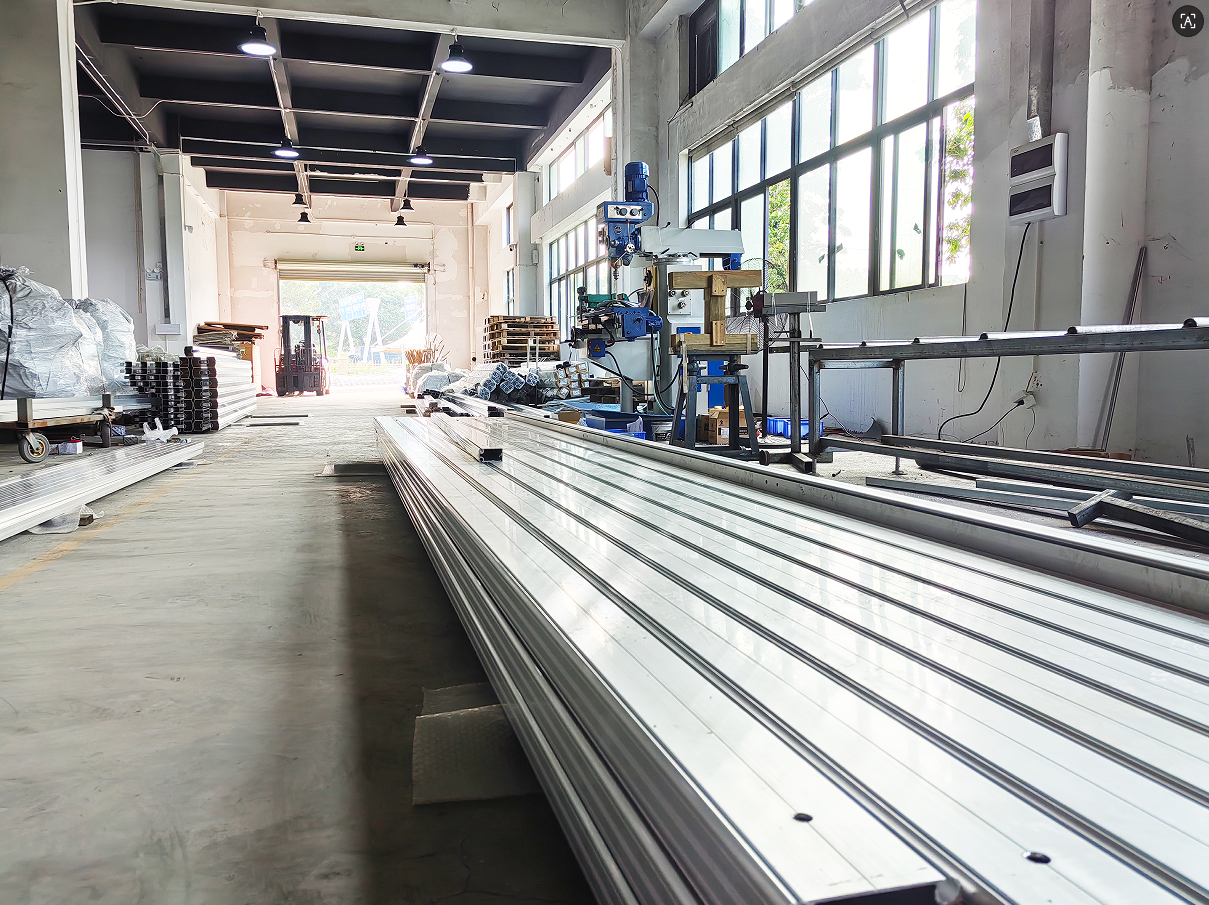
Galvanized steel frame components in the hardware workshop; frame gauge and coating form part of the same documented material stack as the cover.
UV protection and coating durability
Fire and water performance are usually tested once, but UV exposure works continuously. Stars Glamping lists UV protection alongside waterproof PVC/PVDF fabric, reinforced steel structure and flame-retardant materials within its documented control measures for water, wind, fire and UV exposure risks. For desert camps and high-altitude sites, the UV statement is not a cosmetic detail: coating degradation is a leading cause of premature cover ageing, and an aged coating weakens both the waterproof and the flame-retardant layer at the same time.
Certification and documentation
Stars Glamping holds CE certification (General Product Safety) for its safari tents, meeting EN ISO 5912:2020 safety and performance standards — the framework European buyers use when a camping or accommodation tent must be documented as a product rather than as a textile. Behind that certificate sits a 12-step quality inspection system, pre-shipment testing, and an R&D team covering architectural design, structural engineering and materials science, with 54 national patents and multiple trademark certifications recorded by the company.
For a compliance file, the useful output of this structure is a document set: the CE scope, the EN ISO 5912:2020 reference, the flame-retardancy report, the fabric specification and the inspection record. A supplier that can produce all five in one package is materially easier to approve than one that can produce only a picture of a certificate.
Seven Verification Steps Before Installation Day
Step 1 — Identify the standard your market accepts
Confirm with the local fire authority and the project insurer which standard applies to guest accommodation on your site. For North America, plan for flame-retardancy standards such as CPAI-84 and NFPA 701 for commercial tent use. For European-facing projects, expect a B1 classification under DIN 4102-1 to be requested for the cover material, supported by CE product safety documentation to EN ISO 5912:2020. Write the accepted standard into the tender document before approaching suppliers.
Step 2 — Ask for the test report, not the claim
Request the actual report or certificate, and check three things on it: the standard named, the material tested, and the issuing body. If a supplier answers a fire question with a marketing sentence, treat that as an open item rather than a satisfied requirement.
Step 3 — Match the tested fabric to the delivered fabric
Cross-check the fabric weight and coating system stated on the certificate against the specification line in your order and the packing documents that arrive with the shipment. A cover specified at a documented weight such as 850 g/m² PVC gives you a concrete reference point for that check.
Step 4 — Verify the waterproofing value in mm H₂O
Waterproofing should be recorded as a measured hydrostatic head in mm H₂O, together with the test method, rather than as an adjective. Tender specifications frequently state a figure such as ≥ 3000 mm H₂O for guest accommodation covers, and in that case the supplier’s report should show a measured value that meets or exceeds it. Published benchmarks from other suppliers are useful for calibration: YALA Canvas Lodges documents canvas with a water-column classification above 400 mm, which illustrates how differently canvas and coated PVC constructions behave and why the value — not the word “waterproof” — is what you specify.
Step 5 — Verify the frame and the anchoring interface
Confirm steel specification, diameter, galvanized coating and connection hardware, then confirm how the structure is anchored on your platform or deck. The Stars Glamping Neptune model uses a 76 mm galvanized steel frame; two units with identical covers but different frames will not deliver identical wind performance.
Step 6 — Assemble the document set for insurers and authorities
Collect in one file: the product-safety document (for example CE covering EN ISO 5912:2020), the flame-retardancy test report, the hydrostatic head result, the UV and coating statement, the material specification sheet, and the factory inspection record. This file is what an insurer, fire officer or tour-operator auditor will ask for, and assembling it before installation avoids a retrofit conversation later.
Step 7 — Lock the delivery, inspection and handover flow
Verification continues after the order. Purchase terms include a minimum order quantity of one unit with samples available, delivery terms of EXW, FOB, CIF or DDP, acceptance based on factory inspection with photo and video confirmation before shipment, and payment by T/T or L/C with negotiated terms for large orders. Standard models carry a typical lead time of 15–20 days, with monthly production capacity of 50–80 luxury tent units depending on project size.
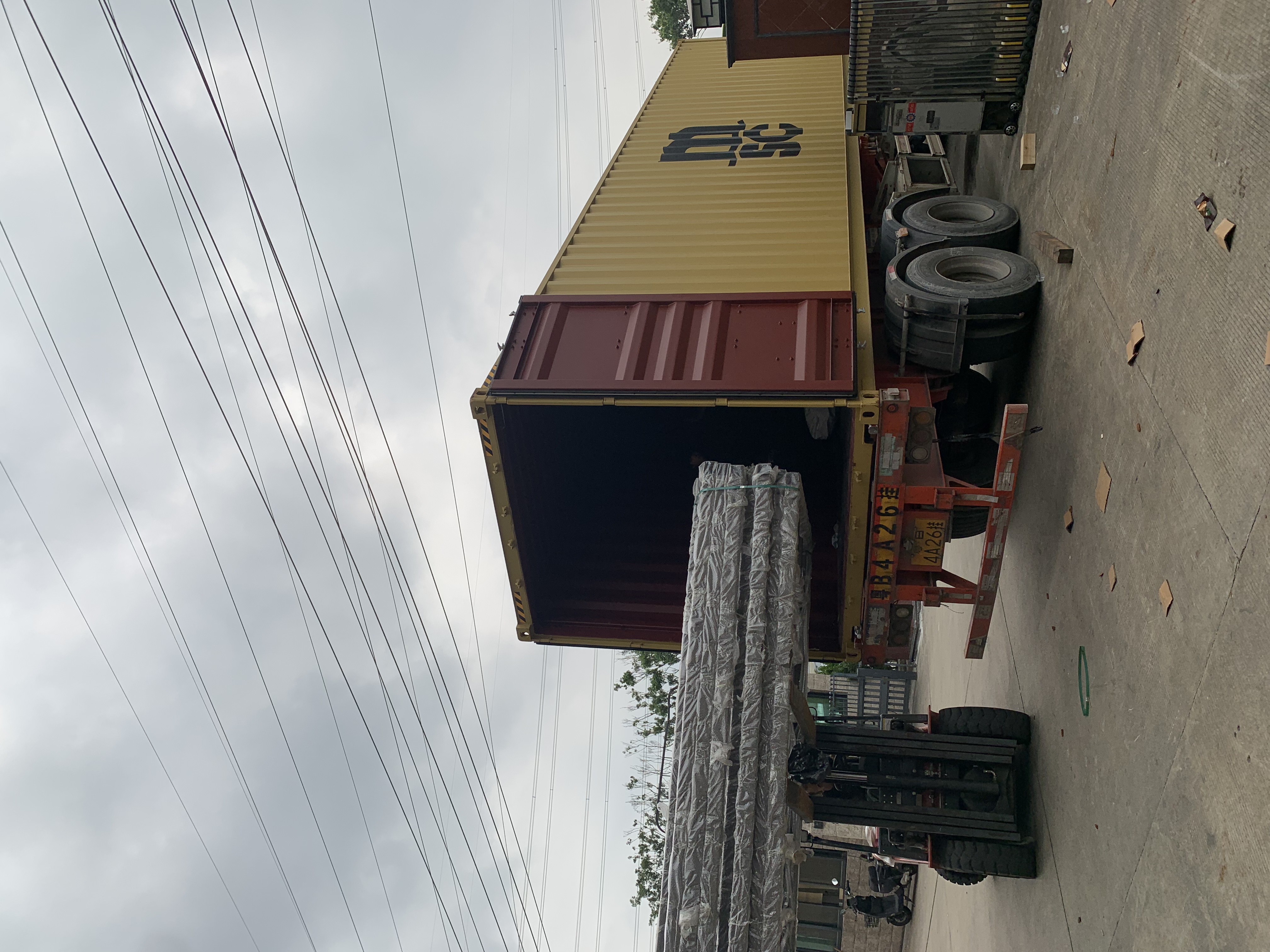
Container loading before shipment; pre-shipment photo and video confirmation forms part of the documented acceptance process.
Use Cases: Where Each Verification Point Changes Weight
Desert camp and high-UV sites
UV exposure dominates the maintenance profile. The UV protection statement and the coating specification on the cover matter more than a marginal difference in water column, because coating degradation is what eventually compromises both waterproofing and flame behaviour.
Jungle and riverside lodges
Humidity and sustained rainfall shift the priority to the measured hydrostatic head in mm H₂O and to corrosion protection on the frame. In this setting, the galvanized steel specification and the coating system are reviewed together, because a sound cover on a corroding frame still fails inspection.
African safari lodges and wildlife camps
With African safari arrivals reaching 81 million international travellers in 2025 — an 8% increase — lodges sold through international operators are increasingly asked for a compliance file at contracting stage. Flame-retardancy documentation and product-safety certificates become commercial documents, not technical ones.
Eco resorts and cold-climate operations
Eco-resort projects usually combine the compliance requirement with a durability requirement, since replacement cycles are a visible sustainability cost. The Stars Glamping range is available in standard sizes of 20 m², 30 m², 40 m² and 50 m² with customization, and features large panoramic windows, mesh screens and a wood-style structure design — configurations that allow fit-out options such as bathroom, kitchen or electrical services to be planned inside a documented structure rather than added on site.
Pre-Installation Verification Table
The table below converts the verification steps into a document checklist that can be attached directly to a tender or purchase order.
| Verification item | What to request from the supplier | Reference standard or public benchmark | Why it matters for guest accommodation |
|---|---|---|---|
| Flame retardancy — North America | Test report naming the standard, the tested fabric and the issuing body | CPAI-84; NFPA 701 for commercial use | Fire authorities and insurers in the US and Canada assess tent accommodation against named standards |
| Flame-retardant classification — Europe-facing specifications | Written classification of the cover material with the test method | B1 classification under DIN 4102-1 | B1 is the classification most frequently written into European cover-material specifications |
| European product safety | CE documentation covering the tent as a product | CE (General Product Safety) to EN ISO 5912:2020 — held by Stars Glamping for its safari tents | Aligns the structure with the safety and performance framework used for camping and accommodation tents in the EU |
| Cover material build | Fabric weight, coating system and batch reference on delivery documents | 850 g/m² PVC cover rated 100% waterproof and flame retardant (Stars Glamping Neptune model) | A heavier coated cover resists abrasion, cleaning and weathering over a longer service life, and keeps the tested material identical to the delivered material |
| UV resistance | Coating specification and UV protection statement | UV protection listed among Stars Glamping’s documented control measures together with waterproof PVC/PVDF fabric, reinforced steel structure and flame-retardant materials | UV exposure is a leading cause of cover ageing in desert and high-altitude camps, and takes the waterproof and flame layers with it |
| Waterproofing | Measured hydrostatic head in mm H₂O and the test method used | Tender lines are commonly written as ≥ 3000 mm H₂O; published canvas benchmark: above 400 mm water column (YALA Canvas Lodges) | Determines comfort, interior damage risk and the credibility of the waterproof claim under sustained rain |
| Frame and anchoring | Steel grade, diameter, galvanized coating, connection and anchoring detail | 76 mm galvanized steel frame (Stars Glamping Neptune model) | Frame rigidity governs how wind load is transferred to the ground instead of into the fabric |
| Documentation at handover | Batch traceability and inspection records | Factory inspection with photo and video confirmation before shipment | Gives the operator a paper trail for insurers, authorities and tour-operator audits |
| Execution readiness | Lead time, delivery terms and installation guidance | MOQ 1 unit with samples available; EXW, FOB, CIF, DDP; 15–20 days for standard models; 50–80 luxury tent units per month depending on project size | Compliance only pays off if the documented structure arrives on schedule and is installed as specified |
Safari tent versus standard camping tent: where the compliance budget goes
| Parameter | Safari tent (glamping accommodation) | Standard camping tent |
|---|---|---|
| Purpose | Luxury accommodation | Temporary shelter |
| Service life | 8–10 years | 1–2 years |
| Best suited to | Safari and eco tourism | Short-stay camping |
| Cost profile | Higher initial cost but better ROI | Lower initial cost with more frequent replacement |
| Maintenance | More durable, less frequent replacement | More frequent replacement |
| Environmental control | Better ventilation and insulation | Basic ventilation |
FAQ
1. Which fire-retardant standard should a safari tent meet for European and North American resorts?
It depends on where the guests sleep. In North America, safari tents used commercially are commonly required to meet flame-retardancy standards such as CPAI-84, with NFPA 701 applying to commercial tent use. For European-facing specifications, projects frequently request a B1 classification under DIN 4102-1 for the cover material, supported by product safety documentation: Stars Glamping holds CE certification (General Product Safety) for its safari tents, meeting EN ISO 5912:2020 safety and performance standards. Buyers should confirm which standard the local fire authority or insurer accepts before placing the order, then require evidence against that specific standard.
2. Can one safari tent fabric system satisfy both fire-retardant and waterproof requirements?
Yes, when the cover is a coated PVC fabric rather than an untreated canvas. In the Stars Glamping range, the Neptune safari tent model is specified with an 850 g/m² PVC cover rated as 100% waterproof and flame retardant, mounted on a 76 mm galvanized steel frame, and UV protection, waterproof PVC/PVDF fabric, reinforced steel structure and flame-retardant materials are documented among the company’s control measures for water, wind, fire and UV exposure risks. The verification point is not the claim but the match: the weight and coating that arrive on site should be the same ones described in the test report.
3. Does verified compliance increase the project budget, and how is that justified?
Compliance-grade materials carry a higher initial cost than temporary structures, but the comparison used by resort buyers shows the trade-off clearly: a safari tent structure is expected to serve 8–10 years against 1–2 years for a standard camping tent, with more durable materials, better ventilation and insulation, and less frequent replacement. Cost drivers on the specification side are the cover weight and coating system, the galvanized steel frame, and the logistics route. Commercial terms are flexible rather than fixed by volume: the minimum order quantity is 1 unit with samples available, delivery terms can be set as EXW, FOB, CIF or DDP, and payment terms include T/T and L/C with negotiated conditions for large orders.
4. Can we validate the materials with a sample before committing to the full order?
Yes. The minimum order quantity of one unit allows a single-unit trial or sample, and acceptance is based on factory inspection with photo and video confirmation before shipment. This is the stage at which a buyer can compare the physical cover against the flame-retardancy report and the stated hydrostatic head value, and confirm that the delivered fabric weight matches the specification. Where the buyer prefers the supplier to manage transport, delivery terms can be arranged as EXW, FOB, CIF or DDP.
5. What lead time and installation support should a resort builder plan for?
Standard models typically ship within 15–20 days, and monthly production capacity runs at 50–80 luxury tent units depending on project size, which allows larger resort programmes to be staged. Installation guidance is provided as part of delivery, and after-sales support follows a 24-hour global response mechanism with lifelong technical support. To move from verification to execution, download the product brochure at Stars Glamping brochure (PDF) or send your site plan, target market and required standard to info@stars-glamping.com so that the documentation pack can be matched to what your fire authority accepts.
Conclusion: Verify the Standard, Then Buy the Tent
B1 fire-retardant performance in a safari tent is a document, not an adjective. The verification chain has a fixed order: confirm the standard your market and insurer accept, obtain the test report that names it, match the tested fabric to the fabric delivered, record the waterproofing value in mm H₂O, confirm the galvanized steel frame and anchoring, and assemble the full file — certificate, report, specification sheet and inspection record — before installation day rather than after.
Where a supplier can answer all of those points with named standards and traceable materials — CE to EN ISO 5912:2020, a documented 850 g/m² PVC cover rated 100% waterproof and flame retardant, a 76 mm galvanized steel frame, and an inspection and delivery process that reaches site on a predictable schedule — the compliance conversation turns into a procurement advantage. For resort builders operating in a market where certified accommodation is increasingly linked to occupancy performance, that advantage compounds over the 8–10 year service life of the structure.

The Stars Glamping manufacturing base in Nansha District, Guangzhou, where safari tent structures are produced, inspected and prepared for shipment.
Next step: build your verification file
Request the specification sheet, the CE / EN ISO 5912:2020 scope, the flame-retardancy report for the cover material and a sample unit for physical review. Download the brochure or send your project requirements directly.
Brochure: Download the Stars Glamping product brochure (PDF)
Website: www.starstent.com
Email: info@stars-glamping.com | Tel / WhatsApp: +86-133 2645 9475
Address: Building A, No.1663 Nansha Avenue, Dongchong Town, Nansha District, 511466, Guangzhou City, China
Stars Glamping (STARS GLAMPING TENT CO., LTD) — founded 2018, 20,000 m² manufacturing base, safari tents supplied to resort, lodge and eco-camp projects in more than 40 countries.
Have Questions or Need More Details?
Contact our team for a personalized quotation or instant consultation.
Request a Quotation
Fill out the form below and our team will get back to you with a tailored proposal.
WhatsApp Direct Chat
Prefer to chat in real-time? Message us on WhatsApp for instant assistance & quick answers.
- Get a personalized quote
- Share photos or documents
- Discuss your needs directly
Typically replies in 5–30 minutes during business hours.