Safari Tent Compliance by Region: A Buyer's Evidence Guide
Short answer: no single safari tent certificate clears every market. Fire rating, hydrostatic head, wind speed, snow load and operating temperature describe what the product can do; each destination market separately decides whether that evidence is acceptable, and in what form. Resort, lodge and eco-camp buyers who keep product performance and jurisdiction-specific approval in two separate files avoid the two most expensive mistakes in tent procurement: assuming a certificate travels, and paying for re-testing because the right document was never requested.
This guide sets out a practical method for building that file. It uses one documented product package — the Safari Tent range from Stars Glamping and the EU attestation held for Safari Tent – Epic — to show which statements are verifiable today, which questions belong to local authorities, and what should be in writing before production starts.
Why one certificate cannot travel with the tent
A conformity document answers a product-safety question about a defined product scope, in a defined market, for a defined period. A planning consent, fire-safety sign-off or electrical inspection answers a question about a specific site. The two are related, but they are not interchangeable, and they are issued by different bodies.
The practical consequence is that a buyer can hold a valid certificate and still be asked for something else once the camp reaches the site. Typical examples: the fire authority wants the test method behind a B1 rating rather than the rating alone; the structural reviewer wants the design wind and snow loads for that location rather than the tent's maximum rating; the electrical inspector wants to see how lighting and air-conditioning circuits were installed. None of these requests means the certificate is wrong. It means the certificate was never designed to answer them.
Decision rule: keep two files. File one holds product evidence — specifications, certificates, test reports and quality records. File two holds project approvals — planning, fire, electrical, water and customs. A supplier fills file one. Only the local authority fills file two.
Industry background: why regional evidence is now a buying criterion
Safari-style accommodation has moved from a niche safari-camp format into mainstream resort development, and the buyer mix has changed with it. Grand View Research projects the global safari tourism market growing from USD 39.7 billion in 2026 to USD 66.9 billion by 2033 (Grand View Research, Safari Tourism Market Size And Share Report, 2026–2033). More projects in more countries means more regulatory environments reviewing the same tent design.
Supply has globalised at the same time. Stars Glamping (STARS GLAMPING TENT CO.,LTD) is a Guangzhou-based manufacturer of glamping domes, safari tents and luxury tents that exports about 90% of its output to Southeast Asia, the Middle East, Africa, Europe, North America, South America and Australia. A supplier working across those markets accumulates documents, but it cannot accumulate local approvals on the buyer's behalf. That gap is where procurement risk sits.
The five performance anchors every regional file starts with
Before regional questions can be answered, the product data has to be precise. The Safari Tent specification applied across the Lodestar, Vega and Epic models states the following:
- Fire: B1 fire-retardant rating on the cover.
- Waterproofing: ≥ 3000 mm H₂O hydrostatic head, on an 850 g/m² PVC-coated polyester outer cover with a breathable Oxford canvas inner lining.
- Wind: wind resistance up to 100 km/h (Level 9 wind).
- Snow: snow load 60 kg/m².
- Temperature: operating range −25 °C to +60 °C.
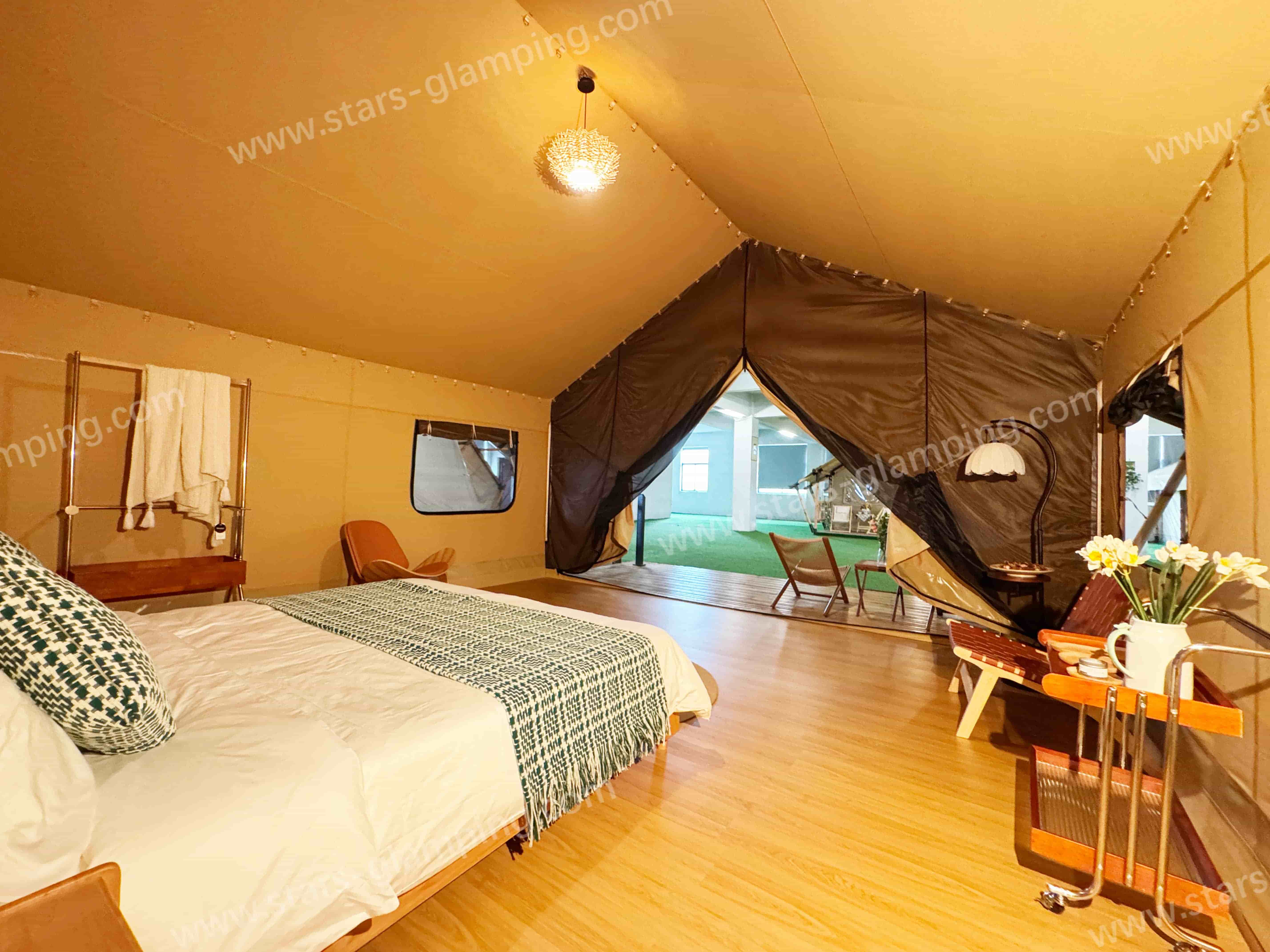
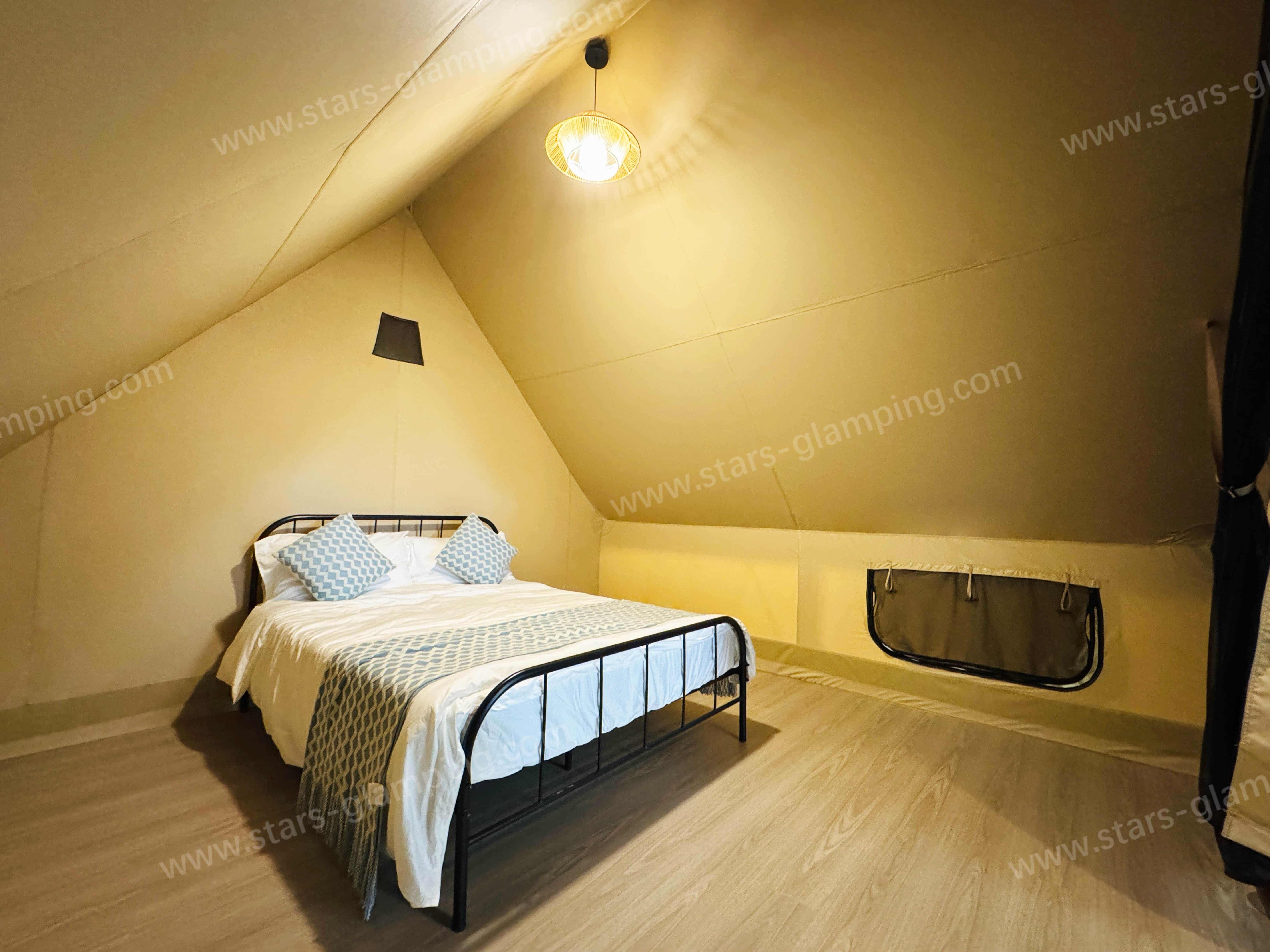
Supporting data in the same specification includes UV resistance and anti-fading treatment, a frame in anti-corrosion solid wood or heavy-duty galvanized steel, standard sizes of 20 m², 30 m², 40 m² and 50 m² (customizable), large panoramic windows with mesh screens, a wood-style structural design, and a stated service life of 8–12 years. Interior fit-out can include insulation lining, wooden flooring, a panoramic glass door, a bathroom module, lighting and air conditioning.
Read the numbers correctly. “Up to 100 km/h” and “60 kg/m²” are product ratings, not approvals for a particular ridge, valley or coastal exposure. A site at altitude, on an exposed ridge or in a snow pocket may need a higher design value, and that calculation belongs to a local structural engineer. Likewise, a B1 rating is a classification; the acceptance question is which test method, and which complete assembly — membrane, lining and insulation together — the local authority will accept.
What the EU file actually contains
For the EU market, the documented file is specific enough to be checked line by line. Safari Tent – Epic holds a General Product Safety Directive Attestation of Conformity (CE), certificate number M.2024.206.C96444, issued by UDEM. The applicable standard is EN ISO 5912:2020, the certificate runs from 31 January 2024 to 30 January 2029, and it applies to the EU market.
The certified scope is broader than one model: it covers tents including Aluminum Frame, ClearSpan, Geodesic Dome, Glamping Dome, Glass Dome, Polycarbonate Dome, Glamping Pods, Safari Lodge and Prefab House. Safari Lodge is named within that scope, and Safari Tent – Epic is the model identified as covered in the product documentation.
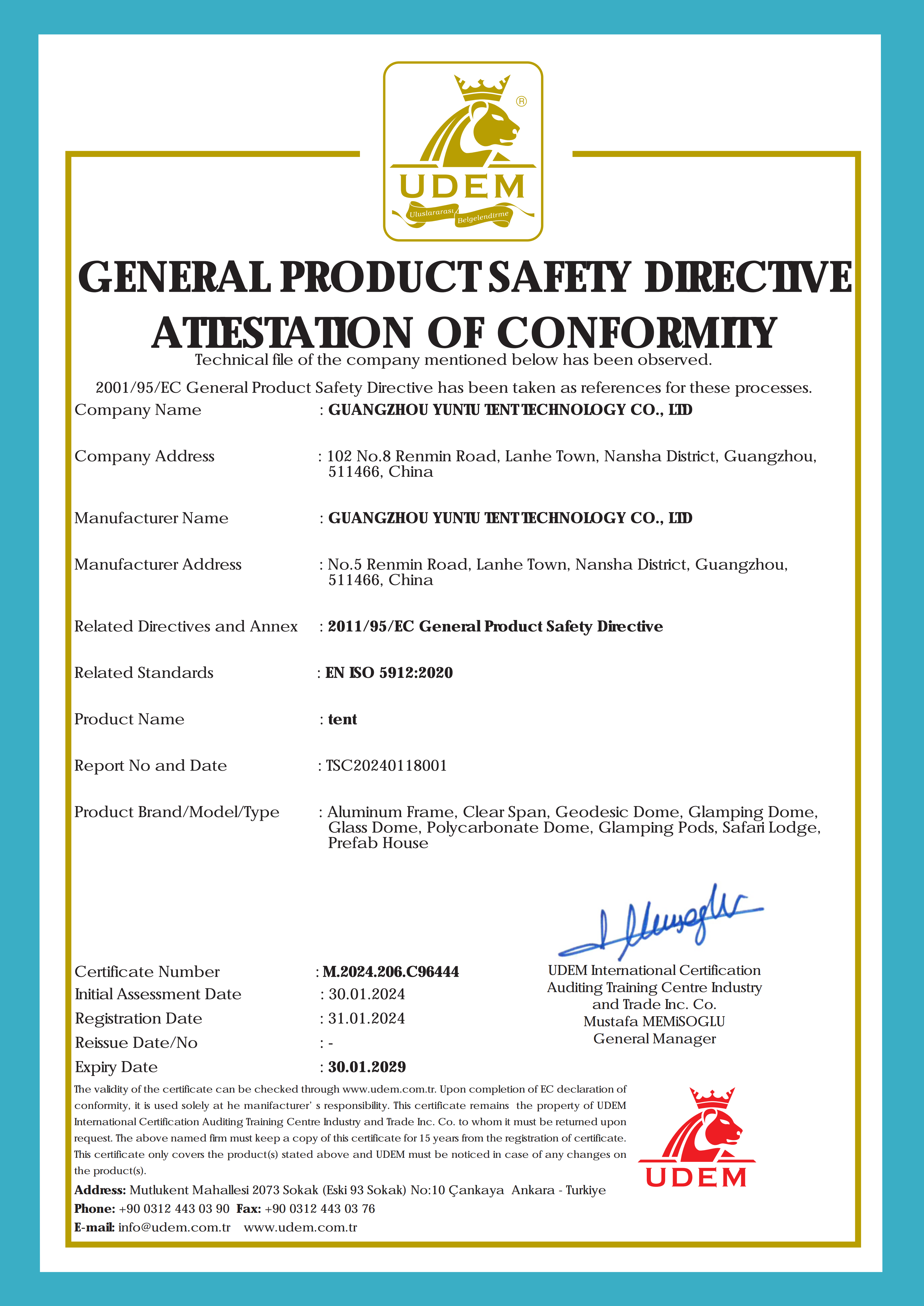
Three checks turn this document into useful procurement evidence rather than a logo on a brochure. First, confirm the model you are buying against the written scope: if the specification names Vega or Lodestar, ask for a model-level coverage statement rather than assuming the whole range is included. Second, diarise the expiry date, because a certificate that lapses before handover becomes the buyer's problem, not the issuer's. Third, keep the attestation in context: it is a product conformity document under the General Product Safety Directive, and it does not replace site planning permission, a fire-safety assessment of the installed camp, or electrical certification of connected services.
Region by region: the questions to ask, not the approvals to assume
The sections below do not claim that any market has approved this product. They identify, for each region, which local questions matter most and which part of the product file is most likely to be requested. Nothing here substitutes for advice from a local authority or licensed professional.
Africa: wildlife camps, lodges and remote sites
African lodge and wildlife-camp projects in the supplied application data include Kenya, Tanzania, Namibia, South Africa, Morocco and Algeria, typically in savannah conditions with high UV, heavy seasonal rain, wind and remote or off-grid operation. The local questions are usually about who grants consent — national park, conservancy or local planning — and how fire safety is demonstrated where water supply is limited. Relevant product evidence: the B1 fire-retardant cover, UV-resistant and anti-fading finish, the 100 km/h wind rating, and after-sales support covering spare parts and remote technical assistance. Confirm import documentation and duty treatment with a local customs broker before shipping; those sit outside the safety document.
Europe: the one market with a named certificate
Europe is the only region in this file with a certificate that names its market, issuer, standard and number. Buyers should still separate the CE attestation from local planning and fire requirements for the site, and should confirm how the local authority wants the fire performance of fabric and insulation evidenced. For mountain or shoulder-season projects, ask the structural engineer to check the 60 kg/m² snow load and the 100 km/h wind rating against the actual site, and confirm the −25 °C lower operating limit against local winter records.
North America: import classification plus local authority review
In the United States, the Harmonized Tariff Schedule classifies synthetic-fibre tents other than backpacking models under 6306.22.90.30, with a general duty rate of 8.8% (USITC, HTS Chapter 6306). That is a cost and import-compliance question, and it is often confused with safety approval. The site questions sit elsewhere: which fire test evidence the local authority having jurisdiction will accept, which design wind and snow values apply, and how the electrical installation will be inspected. Treat the tariff line and the safety file as two separate documents with two separate owners.
Southeast Asia: waterproofing and humidity
Thailand, Indonesia, Malaysia, Vietnam and the Philippines appear in the application data with heavy rain, humidity and jungle or riverside settings. Here the ≥ 3000 mm H₂O hydrostatic head and the breathable Oxford canvas lining carry most of the conversation, supported by mesh screens for ventilation and a galvanized steel frame where coastal salt exposure is a factor. Typical local questions concern drainage and site preparation, electrical earthing, wastewater, and how the camp manages mould risk during a humid season. Those are design and operations questions that the tent specification supports but cannot settle alone.
Middle East: heat, UV and desert camps
Desert camp projects put the upper end of the operating range under pressure. The specification's +60 °C limit and the UV-resistant, anti-fading cover are the relevant data points, together with insulation lining and air conditioning in the fit-out list. Local questions usually concern heat management, dust ingress through mesh, water supply and fire response in a remote location. Ask for the insulation and air-conditioning specification together with the tent data, because the internal temperature a guest experiences depends on the fit-out package, not on the cover alone.
Australia: UV, coastal exposure and fire evidence
Australia and New Zealand appear in the application data, and the dominant technical themes are UV, wind and coastal exposure. The B1 fire-retardant rating, UV-resistant finish and 100 km/h wind rating are the first documents to prepare. Local questions to settle early: the fire evidence the relevant authority will accept for the site, how timber components and packaging are treated for import, and which wind category applies to the specific location. Ask these before confirming the frame specification.
South America: documentation in the buyer's language
South America is listed among the export markets, and projects there often combine humid lowland and cooler highland sites. The product questions are familiar — waterproofing, UV, wind and, at altitude, the practical meaning of the stated temperature range. The administrative questions are different: import registration, documentation in Spanish or Portuguese, and which local professional signs off the installed structure. Request translated specification sheets and drawings at quotation stage rather than after the order.
Regional acceptance checklist
The table maps each region to the local approval question, the product evidence that supports it, and the document to keep on file. It is a planning aid, not a statement that any listed approval has been obtained.
| Market | Local approval to confirm | Most relevant product evidence | Document to keep |
|---|---|---|---|
| Africa (Kenya, Tanzania, Namibia, South Africa, Morocco, Algeria) | Park, conservancy or local planning consent; fire response at remote sites; off-grid electrical check | B1 fire-retardant cover; UV-resistant, anti-fading finish; 100 km/h wind rating; spare parts and remote technical support | Certificate pack, drawings, maintenance and spares plan |
| Europe | Site planning permission; local fire assessment of the installed camp; structural check against site snow and wind | CE attestation M.2024.206.C96444 (UDEM, EN ISO 5912:2020, valid to 30 January 2029); 60 kg/m² snow load; 100 km/h wind rating; −25 °C limit | CE attestation plus model-scope statement and structural review |
| North America | Authority having jurisdiction: accepted fire evidence, design wind and snow, electrical inspection | B1 rating; ≥ 3000 mm H₂O waterproofing; 850 g/m² PVC-coated polyester cover; wind and snow ratings | HTS 6306.22.90.30 entry (8.8% general duty, USITC) kept separate from the safety file |
| Southeast Asia | Drainage and site preparation; electrical earthing; wastewater; humidity management | ≥ 3000 mm H₂O waterproofing; breathable Oxford canvas lining; mesh screens; galvanized steel frame option | Specification sheet, fit-out drawings, maintenance guidance |
| Middle East | Heat management; water supply; remote fire response; import conformity | +60 °C upper operating limit; UV-resistant cover; insulation lining and air-conditioning fit-out | Specification sheet with the full fit-out package |
| Australia and New Zealand | Fire evidence accepted for the site; local wind category; import treatment for timber components | B1 rating; UV-resistant finish; 100 km/h wind rating; solid wood or galvanized steel frame | Certificate pack plus import and treatment records |
| South America | Import registration; documentation in Spanish or Portuguese; local professional sign-off | Waterproofing, UV and wind data; temperature range for highland sites | Translated specification and drawings |
Six steps to build the compliance dossier
- Fix the site design basis. Record design wind speed, snow load, temperature range and exposure for the actual plot, signed off by a local engineer. Compare those values with the tent's 100 km/h, 60 kg/m² and −25 °C to +60 °C ratings, and note any gap in writing.
- Write a numbered specification. One line per requirement with units: B1 fire rating, ≥ 3000 mm H₂O, 850 g/m² PVC-coated polyester cover, frame material, size, insulation, bathroom module, lighting. A numbered list is enforceable; a brochure is not.
- Request the document pack at RFQ stage. Ask for the certificate with number, issuer, standard, scope and validity dates, plus model-level coverage, the test reports behind the fire and waterproofing claims, and drawings. For the EU file this means M.2024.206.C96444, UDEM, EN ISO 5912:2020, valid to 30 January 2029.
- Map each document to its authority. Planning, fire, electrical, water and customs each accept different paperwork. Mark who holds the original and when it must be renewed.
- Agree inspection points before production. Raw-material inspection, in-process checks and pre-shipment inspection can be supplemented by third-party inspection on request. Name the witness points in the purchase order.
- Build the handover file. Certificates, as-built drawings, maintenance instructions, spare-parts list and the renewal calendar. With a stated 8–12 year service life, the renewal and spares plan matters more than the launch date.
Use cases: how site type shifts the emphasis
Desert camp, Middle East. Priority evidence: UV resistance, the +60 °C upper limit, insulation and cooling fit-out. The compliance conversation is dominated by heat management and remote fire response rather than by rain.
Jungle or riverside resort, Southeast Asia. Priority evidence: ≥ 3000 mm H₂O waterproofing, breathable lining, mesh ventilation and corrosion protection on the frame. Local attention goes to drainage, humidity and electrical safety.
Wildlife camp or African lodge. Priority evidence: fire-retardant cover, UV stability, wind rating and access to spare parts. Remote sites make after-sales response part of the compliance case, because a repair delay becomes both a safety and a guest-experience issue.
Mountain or winter project, Europe or North America. Priority evidence: 60 kg/m² snow load, −25 °C operating limit and insulation lining. The engineer's site-specific snow and wind figures should be on the table before the frame specification is frozen.

Where the evidence stops
Honesty about boundaries is part of the file. The supplied documentation identifies one market-specific certificate — the EU attestation — and contains no verified approvals for Africa, North America, Southeast Asia, the Middle East, Australia or South America. The performance figures are supplier specifications; independent laboratory reports for fire classification, UV ageing and tear strength were not part of the package reviewed here. The certificate names Safari Tent – Epic and includes Safari Lodge within its scope, so Vega and Lodestar buyers should request written model-level confirmation. And every number remains subject to site conditions: a 100 km/h rating is not a site wind study, and 60 kg/m² is not a roof-load calculation for a particular location.
FAQ
Does a CE attestation make a safari tent compliant in every market?
No. The Stars Glamping CE file is a General Product Safety Directive Attestation of Conformity for the EU market: certificate M.2024.206.C96444 issued by UDEM under EN ISO 5912:2020, valid from 31 January 2024 to 30 January 2029, covering Safari Tent – Epic and naming Safari Lodge within a wider tent scope. Buyers in other regions still need local planning, fire and electrical acceptance, which the attestation supports but does not replace.
Which performance figures should be written into the supply contract?
Put the B1 fire-retardant rating, ≥ 3000 mm H₂O waterproofing, wind resistance up to 100 km/h (Level 9), 60 kg/m² snow load, −25 °C to +60 °C operating range and the 850 g/m² PVC-coated polyester cover into the specification, each paired with the document that proves it. A figure without a named test or certificate is difficult to enforce after delivery.
Do the same specifications work for desert and jungle camps?
They set a common baseline, but the emphasis changes. Desert camps lean on UV resistance, the +60 °C upper limit, and insulation with air conditioning; jungle and riverside camps lean on ≥ 3000 mm H₂O waterproofing, breathable lining and mesh ventilation. Both need a local engineer to confirm wind and structural values for the actual site.
What should a sample or pre-production unit prove?
A single unit can be ordered as a sample, which makes it a practical verification step: check fabric weight and finish, frame joints and galvanized coating, window and mesh detailing, lining fit, and how the bathroom module and lighting integrate. Raw-material, in-process and pre-shipment inspections can be witnessed, and third-party inspection is available on request.
How long do documentation and production take?
Standard models are quoted at 15–20 days and customized projects at 20–30 days, so the document pack should be requested at RFQ stage rather than after the order is placed; scope statements and translated specifications take time to prepare. Installation guidance, drawings, 24/7 technical support and spare-parts supply continue after delivery. The full specification set is available in the Stars Glamping product brochure, and market-specific questions can be raised directly with Stars Glamping.
Conclusion
Compliance for a safari tent is not a single document; it is a matched pair. On one side sits product evidence that can be checked today: a B1 fire-retardant cover, ≥ 3000 mm H₂O waterproofing, wind resistance up to 100 km/h (Level 9), 60 kg/m² snow load, −25 °C to +60 °C operating range, and an EU attestation numbered M.2024.206.C96444 with a defined scope and expiry. On the other sits the site file that only local authorities and licensed professionals can complete.
Buyers who build both files before signing — with a numbered specification, a document pack, named inspection points and a renewal calendar — get the benefit of the performance data without overstating it. That is the difference between a certificate that looks reassuring in a meeting and evidence that holds up when the camp is inspected.
Have Questions or Need More Details?
Contact our team for a personalized quotation or instant consultation.
Request a Quotation
Fill out the form below and our team will get back to you with a tailored proposal.
WhatsApp Direct Chat
Prefer to chat in real-time? Message us on WhatsApp for instant assistance & quick answers.
- Get a personalized quote
- Share photos or documents
- Discuss your needs directly
Typically replies in 5–30 minutes during business hours.