
Luxury Hotel Tent Site Fit: Matching Structure, Fabric, and Systems to Real Resort Conditions
Luxury Hotel Tent Site Fit: Matching Structure, Fabric, and Systems to Real Resort Conditions
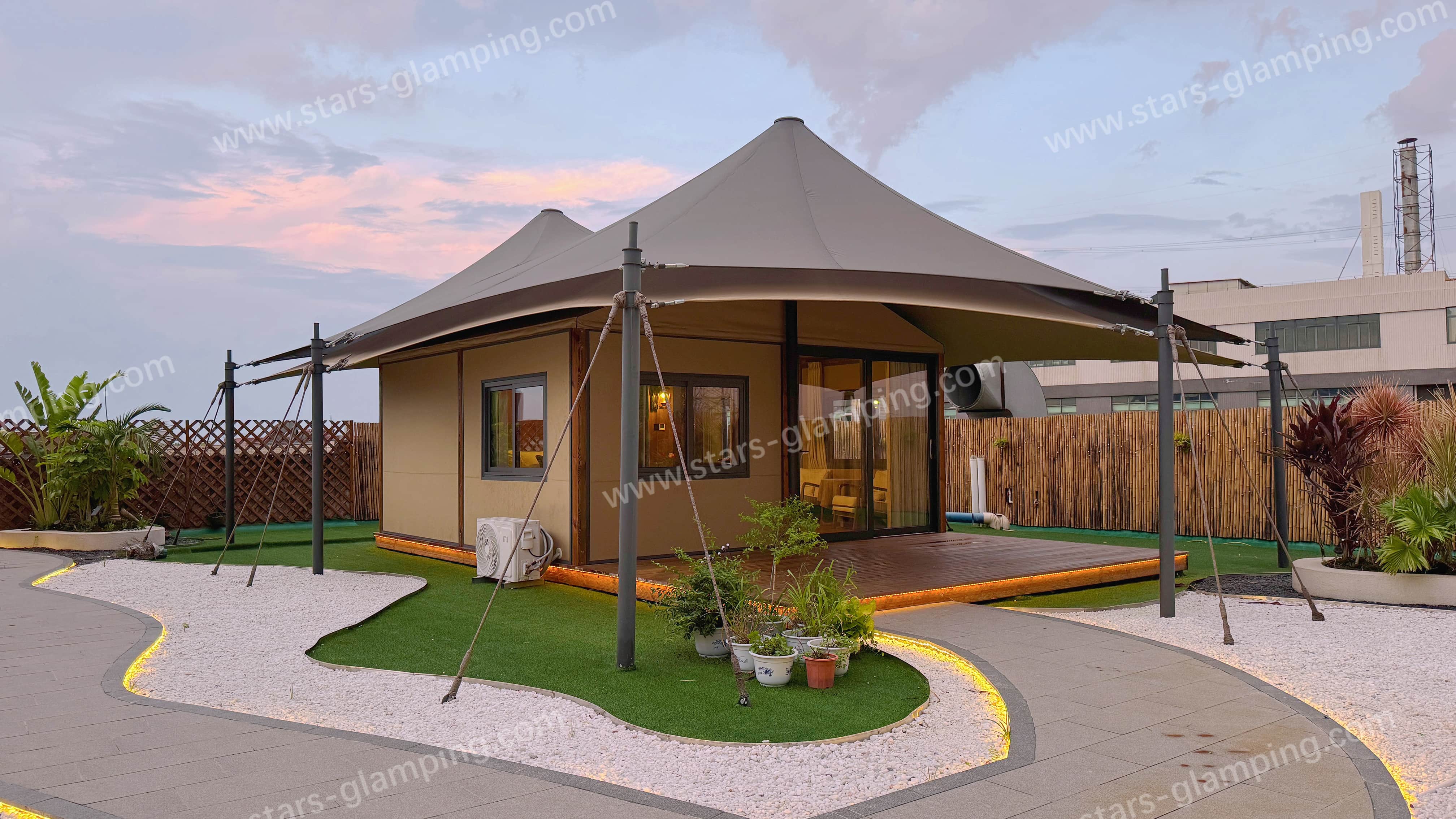
When a resort developer evaluates a luxury hotel tent, the first questions usually involve price per unit, visual design, and delivery time. But for projects that operate 24/7 as permanent hotel accommodation, the decisive factors are site-specific: wind loads, temperature range, humidity, UV intensity, snow load, coastal salt exposure, and local fire safety requirements. A tent specified without reference to these conditions can face early fabric aging, heat buildup, wind damage, or compliance rejection. This guide explains how to match luxury hotel tent structures, membrane fabrics, wall systems, and integrated equipment to real resort project conditions, using verified product data and completed cases from Stars Glamping, a Guangzhou-based manufacturer of luxury glamping tents and resort accommodation structures.
The Core Problem: Why Site Conditions Change the Tent Specification
A luxury hotel tent is not a one-specification product. Beach resorts, desert resorts, mountain lodges, eco-tourism camps, and safari lodges place very different demands on the same structure.
Coastal sites combine high humidity, salt spray, and strong winds. Desert sites create extreme daytime heat, UV exposure, and dust. Mountain sites add snow loads, low temperatures, and gusty wind. Eco-lodge and safari sites often require minimal environmental impact, off-grid operation, and natural ventilation. If the frame material, fabric specification, wall system, and interior equipment are not matched to these conditions, the long-term operating cost can exceed the initial saving of choosing a generic tent.
Industry Background: From Seasonal Tents to Permanent Hotel Assets
The glamping market was valued at approximately USD 3.8 billion in 2025, with tents representing a major accommodation segment alongside cabins and pods, according to Grand View Research. Fortune Business Insights projects the market will reach USD 9.15 billion by 2034, growing at a CAGR of 10.67%. Europe accounted for the largest regional share at 35% in 2025, based on Grand View Research data.
As the market grows, more developers are treating luxury hotel tents as permanent hotel assets rather than temporary seasonal structures. This shift increases the importance of structural engineering data, fabric durability, environmental adaptation, and fire compliance. Resort developers now need suppliers that can document material specifications, customization capabilities, completed project references, and after-sales support.
Detailed Solution: Matching Tent Systems to Four Environment Types
Beachfront and Island Resort Requirements
For a beachfront or island resort, the essential performance requirements are waterproofing, wind resistance, and corrosion resistance in a high-humidity coastal environment.
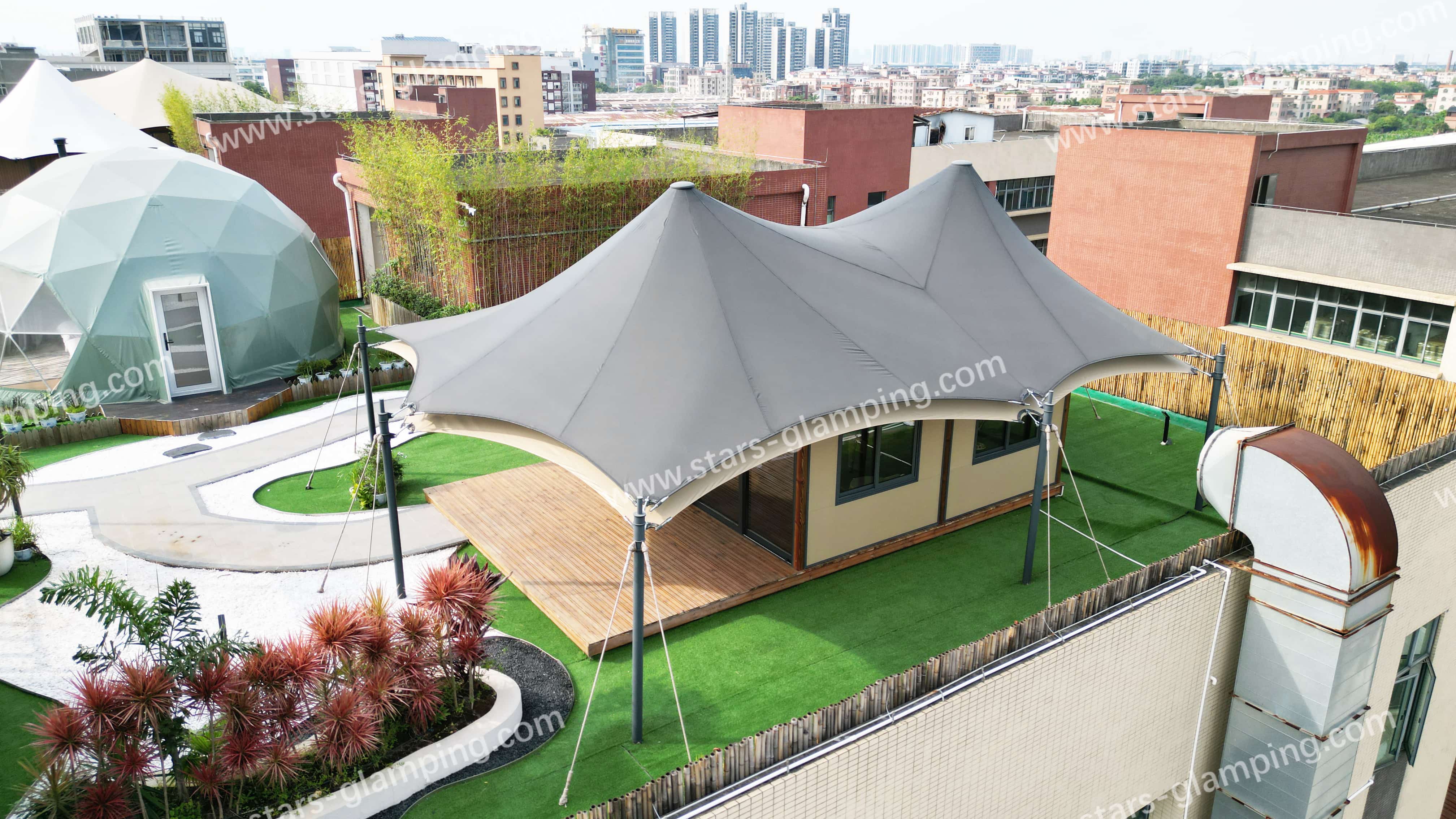
Stars Glamping's luxury hotel tent models use either 1050g/m² PVDF Architectural Membrane Fabric or 850g/m² PVC Polyester Fabric as the cover material. Both fabrics provide a waterproof rating of ≥5000mm H₂O. Wind resistance reaches up to 120km/h, equivalent to Level 10 wind, across the Pisces, Shell, Octagon, Villa, and Tethys models. The frame is primarily steel pipe, with some models incorporating solid wood.
A completed beachfront project in India illustrates this configuration. Government tourism developers deployed 100 luxury tents as full-resort accommodation. The project highlighted environmentally friendly material selection, high wind resistance, thermal insulation, and panoramic views, with the stated result of enhanced guest experience and increased resort occupancy.
Desert Resort Requirements
Desert resort projects require thermal insulation, UV resistance, and the ability to handle large temperature swings between day and night.
The operating temperature range for the Stars Glamping tent system is -30℃ to +70℃, which covers the extremes found in desert climates. The membrane fabric is UV stabilized and anti-aging. For projects that need stronger thermal performance, the tent can be combined with an insulated glass wall system or an insulated canvas wall system, depending on the model.
In Saudi Arabia, a resort developer completed a 30-unit desert resort project using Stars Glamping luxury tents for long-term permanent accommodation. The project applied custom desert design, high wind resistance, thermal insulation, and panoramic views, with the same operating result: enhanced guest experience and higher resort occupancy.
Mountain and Cold Climate Requirements
Mountain sites introduce structural loads that flat coastal sites do not: snow accumulation, low temperatures, and strong updrafts.
The Stars Glamping tent models are rated for a snow load of 80kg/m² and wind resistance up to 120km/h. The temperature resistance range of -30℃ to +70℃ allows operation in cold mountain environments. Thermal insulation is provided by the wall system rather than by the membrane alone, which is why the insulated glass wall system and insulated canvas wall system are part of the model specification.
A mountain resort project in Nepal delivered 19 luxury tents for full-resort guest accommodation. The project used custom mountaintop design with high wind resistance, thermal insulation, and panoramic views, and was planned for long-term permanent use.
Eco-tourism and Safari Lodge Requirements
Eco-tourism projects add constraints that are less relevant in conventional resorts: low environmental footprint, off-grid capability, and natural ventilation.
Stars Glamping's solution for this segment has been applied in Cape Verde, where 12 luxury hotel tents were installed for wildlife safari accommodation. The project used eco-friendly materials, an off-grid solution, and natural ventilation design. It was planned for long-term outdoor use of more than 8 years, and the documented result was an improved eco-tourism experience and a stronger draw for international tourists.

Step-by-Step: How to Specify a Site-Adapted Luxury Hotel Tent
The following workflow can be used during the research and evaluation phase of a resort project.
Step 1: Document the Site Conditions
Record the wind speed, snowfall, temperature range, humidity, salt exposure, and UV intensity for the exact plot. This data determines which specification parameters must be prioritized.
Step 2: Define the Operating Model
Decide whether the tents will run as 24/7 permanent accommodation, seasonal lodging, or event space. Permanent all-season operation requires a stronger specification than seasonal use.
Step 3: Select the Tent Model Family
Stars Glamping offers five luxury tent models: Tethys, Villa, Octagon, Shell, and Pisces. All five are designed for resort accommodation, beachfront hotel, mountain eco-lodge, desert glamping, and event applications. The structural differences between models affect frame material, wall system, and service life.
Step 4: Confirm the Fabric and Frame System
The cover material is either 1050g/m² PVDF Architectural Membrane Fabric or 850g/m² PVC Polyester Fabric. The frame is steel pipe, with the Pisces model adding solid wood to the frame structure. PVDF models have a service life of 25–30 years; the PVC-based Pisces model has a service life of 10–15 years.
Step 5: Confirm the Wall and Insulation System
Models using the PVDF specification are built with a steel frame, PVC/PVDF fabric, and an insulated glass wall system. The Pisces model uses a steel frame, PVC fabric, and an insulated canvas wall system. The choice affects thermal performance, view quality, and maintenance behavior.
Step 6: Plan the Integrated Equipment Package
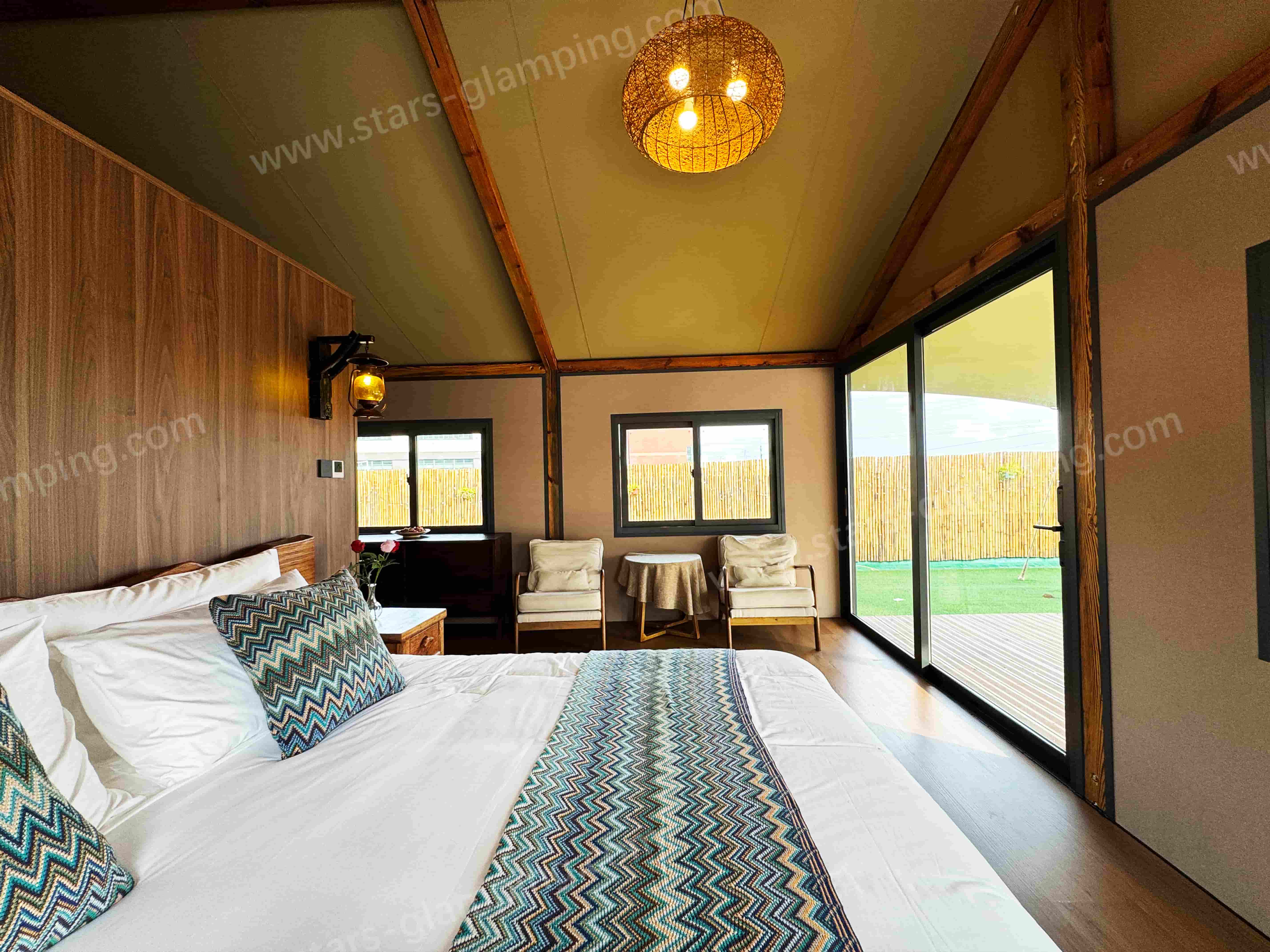
For resort use, the tent system is typically integrated with an air conditioning system, insulation lining, glass doors and panoramic windows, wooden flooring, bathroom modules with shower and toilet, electrical and lighting systems, and curtain and shading systems. These are part of a complete glamping resort fit-out rather than a standalone tent shell.
Step 7: Verify Production Compliance and Factory Capability
Before ordering, confirm that the supplier can support customization, inspection, and delivery planning. Stars Glamping operates OEM and ODM production with a minimum order quantity of one unit, a monthly capacity of 50–80 luxury tent units depending on project size, and a 12-step quality inspection system. Third-party inspection can be arranged.
Use Cases: Resort Projects with Different Site Challenges
Nepal — Mountain Resort: 19 luxury tents for a full resort project in long-term permanent use. Custom mountaintop design with high wind resistance, thermal insulation, and panoramic views. Result: enhanced guest experience and increased resort occupancy.
India — Beachfront Resort: 100 luxury tents commissioned by government tourism developers for a full beachfront resort project. Environmentally friendly materials, high wind resistance, thermal insulation, and panoramic views. Result: enhanced guest experience and increased resort occupancy.
Saudi Arabia — Desert Resort: 30 luxury tents for a full desert resort project in long-term permanent use. Custom desert design with high wind resistance, thermal insulation, and panoramic views. Result: enhanced guest experience and increased resort occupancy.
Cape Verde — Safari Lodge: 12 luxury hotel tents for wildlife safari accommodation, planned for more than 8 years of outdoor use. Eco-friendly materials, off-grid solution, and natural ventilation design. Result: improved eco-tourism experience and attracted more international tourists.
Model Comparison: Key Specification Differences
The table below compares the five luxury tent models based on published product specifications. The main procurement decision point is the material system: PVDF-based models offer a longer service life, while the Pisces model offers a mixed solid wood and steel frame.
| Specification | Pisces | Shell | Octagon | Villa | Tethys |
|---|---|---|---|---|---|
| Frame material | Solid wood + steel pipe | Steel pipe | Steel pipe | Steel pipe | Steel pipe |
| Cover material | 850g/m² PVC polyester fabric | 1050g/m² PVDF architectural membrane | 1050g/m² PVDF architectural membrane | 1050g/m² PVDF architectural membrane | 1050g/m² PVDF architectural membrane |
| Waterproof rating | ≥5000mm H₂O | ≥5000mm H₂O | ≥5000mm H₂O | ≥5000mm H₂O | ≥5000mm H₂O |
| Fire rating | B1 / M2 | B1 / M2 | B1 / M2 | B1 / M2 | B1 / M2 |
| Wind resistance | Up to 120km/h | Up to 120km/h | Up to 120km/h | Up to 120km/h | Up to 120km/h |
| Snow load | 80kg/m² | 80kg/m² | 80kg/m² | 80kg/m² | 80kg/m² |
| Temperature range | -30℃ to +70℃ | -30℃ to +70℃ | -30℃ to +70℃ | -30℃ to +70℃ | -30℃ to +70℃ |
| Service life | 10–15 years | 25–30 years | 25–30 years | 25–30 years | 25–30 years |
| Wall system | Insulated canvas wall system | Insulated glass wall system | Insulated glass wall system | Insulated glass wall system | Insulated glass wall system |
FAQ: Common Questions from Resort Developers
Do luxury hotel tents meet fire retardancy and building code requirements?
Stars Glamping luxury hotel tents are produced with fire-retardant cover materials rated B1 / M2. For commercial hospitality projects, developers should verify that the tent system meets the applicable regional fire safety standard, such as NFPA 701 in the US or EN 13501-1 in Europe. The supplier can provide engineering drawings and technical documentation to support a project-specific compliance review.
Can luxury hotel tents be customized for different environments and fitted with bathrooms and air conditioning?
Yes. Stars Glamping provides OEM and ODM production covering size and layout customization, tent structure design, fabric material selection including PVC, PVDF, and insulation options, frame material selection, interior layout and furniture, bathroom integration, logo branding, and color customization. The standard equipment package includes air conditioning, insulation lining, glass doors and panoramic windows, wooden flooring, bathroom modules, electrical and lighting systems, and curtain and shading systems.
What factors influence the budget of a luxury hotel tent project?
The project budget is driven by the number of units, selected model, fabric and frame specification, interior fit-out level, and custom engineering requirements. Because each project is configured individually, Stars Glamping does not publish fixed unit pricing. The minimum order quantity is one unit, and sample orders are available so developers can evaluate an actual tent before proceeding with a full project order.
Can I inspect a sample or visit the factory before ordering?
Stars Glamping operates a 4000m² simulation exhibition hall at its manufacturing base in Nansha District, Guangzhou. Buyers can inspect product models at the showroom, review production quality, and discuss customization requirements directly with the team. The minimum order quantity is one unit, which also allows a sample-based evaluation process.
What is the lead time for standard and customized luxury hotel tents?
Standard models have a production lead time of 15–20 days, while customized projects typically require 20–30 days. The factory has a monthly capacity of 50–80 luxury tent units depending on project size. Overseas delivery generally takes 15–30 days after production. For a project-specific schedule, contact the Stars Glamping sales team with your unit quantity and customization scope.
Conclusion: Evaluate the Site First, Then the Tent
For resort developers in the research and evaluation phase, the most practical approach is to treat the luxury hotel tent as an engineered accommodation system that must match the site, the operating model, and the local compliance framework. The verified product data from Stars Glamping shows that material selection directly affects service life: PVDF architectural membrane models are specified for 25–30 years, while the PVC-based Pisces model is specified for 10–15 years. Site conditions determine which structural parameters — insulation, snow load, wind resistance, waterproofing, and wall system — deserve the highest priority in the specification.
Completed projects in Nepal, India, Saudi Arabia, and Cape Verde provide field evidence that the same product family can be adapted to mountain, beachfront, desert, and safari lodge environments when the design and equipment package are matched to the use case.

To evaluate whether a specific model fits your resort project, the next step is to share your site conditions, planned number of units, and room configuration with the Stars Glamping team. You can also download the company brochure for an overview of production capabilities, models, and full-chain services.
Have Questions or Need More Details?
Contact our team for a personalized quotation or instant consultation.
Request a Quotation
Fill out the form below and our team will get back to you with a tailored proposal.
WhatsApp Direct Chat
Prefer to chat in real-time? Message us on WhatsApp for instant assistance & quick answers.
- Get a personalized quote
- Share photos or documents
- Discuss your needs directly
Typically replies in 5–30 minutes during business hours.