
Material and Supplier Selection for Luxury Hotel Tents: PVC vs. PVDF and Chinese vs. International Brands – A Procurement Guide for Resort Developers
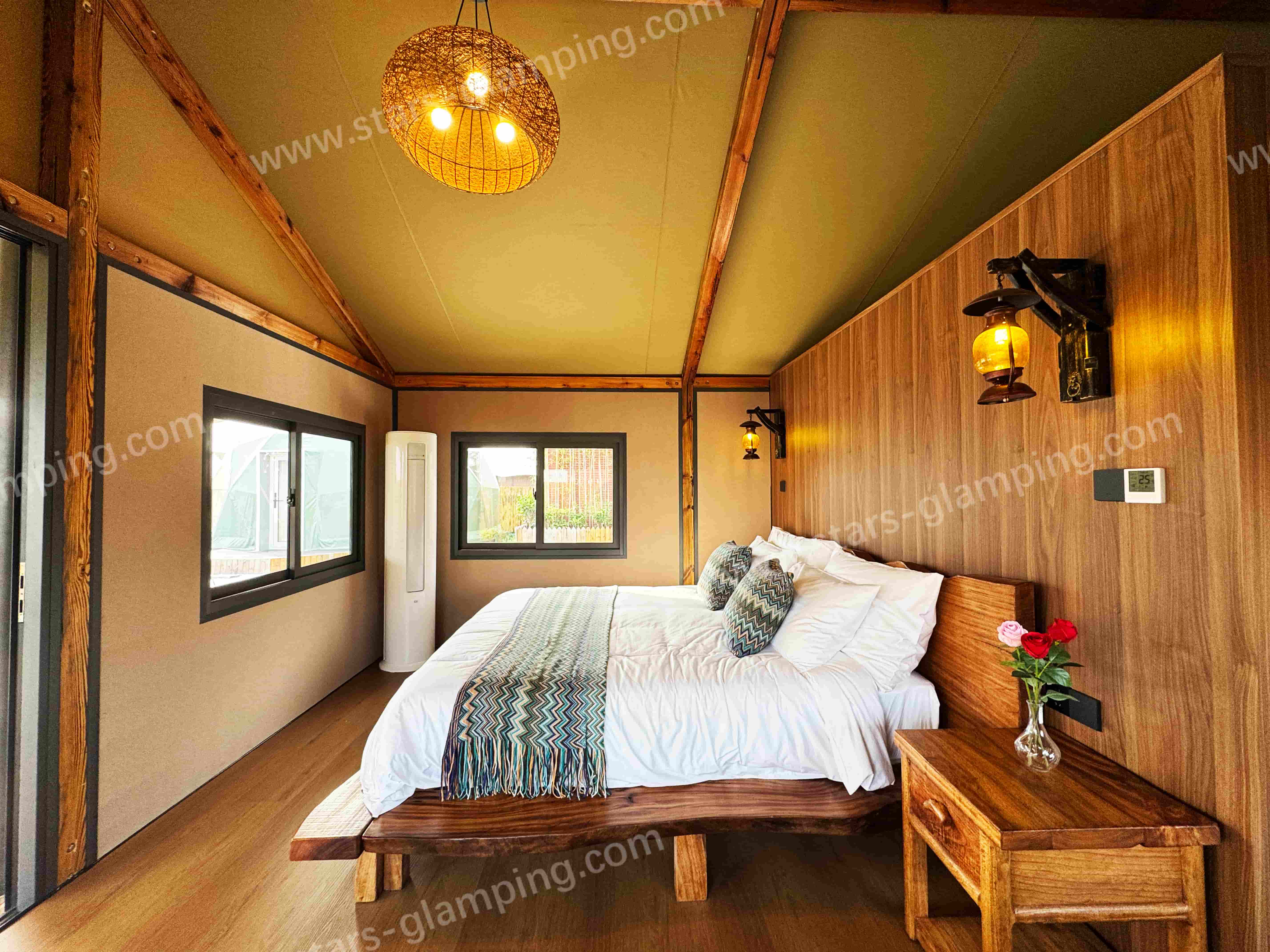
For procurement professionals evaluating luxury hotel tent solutions for resort projects, the choice between fabric types and supplier origins often determines both project feasibility and long-term operational costs. This guide provides a structured comparison of PVC and PVDF membrane models, and contrasts the capabilities of a leading Chinese manufacturer — Stars Glamping — against established international brands, using publicly available industry information.
1. Product Comparison: PVC (Pisces) vs. PVDF (Shell) Models
The analysis below uses two representative models from Stars Glamping: the Luxury Tent – Pisces (PVC fabric) and the Luxury Tent – Shell (PVDF fabric). Both are designed for permanent resort accommodation and comply with fire rating B1/M2, wind resistance up to 120 km/h, and snow load of 80 kg/m².
| Dimension | PVC Model (Pisces) | PVDF Model (Shell) |
|---|---|---|
| Technical Parameters | Frame: Solid Wood + Steel pipe Cover: 850 g/m² PVC polyester fabric Waterproof: ≥5000 mm H₂O Temp range: -30°C to +70°C Service life: 10–15 years |
Frame: Steel pipe Cover: 1050 g/m² PVDF architectural membrane Waterproof: ≥5000 mm H₂O Temp range: -30°C to +70°C Service life: 25–30 years |
| Applicable Scenarios | Ideal for beachfront resorts, eco-tourism camps, and seasonal operations where cost sensitivity is high. | Suited for permanent installations in desert, mountain, or luxury safari lodges requiring longer durability and better thermal performance. |
| Cost | Lower initial investment. The use of PVC fabric reduces material cost by an estimated 30–50% compared to PVDF alternatives. (Based on industry procurement data.) | Higher upfront cost due to premium PVDF membrane. However, the longer lifespan (25–30 years vs. 10–15 years) lowers total cost of ownership over two decades. |
| Maintenance Difficulty | Standard cleaning and periodic seam inspection; PVC may require replacement sooner in high-UV climates. | PVDF fabric is self-cleaning and more resistant to UV and chemical degradation. Maintenance intervals are longer but professional cleaning is occasionally needed. |
Both models deliver an installation time of 20–30 days, compared to the 6–12 month construction period for traditional buildings, as noted in supplier documentation. The PVDF model offers better insulation properties that contribute to reduced energy consumption over its service life.
2. Supplier Comparison: Chinese Manufacturer vs. International Brands
This section compares Stars Glamping (China) with two internationally recognized luxury tent brands — Lotus Belle (UK) and Safari Tent Company (South Africa) — using publicly available market information and the company’s published capabilities.
| Criterion | Stars Glamping (China) | Lotus Belle (UK) | Safari Tent Company (SA) |
|---|---|---|---|
| Price (per unit, est.) | 30–50% lower than comparable European/African products (based on industry cost analysis). | Premium pricing reflecting UK craftsmanship and brand heritage; typical 20–30% higher than Chinese equivalents. | Mid-to-high range; African manufacturing yields cost advantage over European brands but still above Chinese OEM pricing. |
| Customization Capability | High – offers size, layout, fabric, frame, interior, and branding customization; MOQ of 1 unit; in-house R&D team of 6 engineers supports modifications. | Limited standard models; custom orders require high MOQ (≥10 units) and longer lead times. | Customization available but primarily focused on traditional safari tent shapes; lead times for non-standard designs typically exceed 12 weeks. |
| Lead Time (for 30 tents) | 15–30 days for overseas orders; 20–30 days for fully customized projects. | 8–12 weeks typical for standard models; longer for custom. | 6–10 weeks for standard; customization adds 4–6 weeks. |
| After-Sales Network | 24/7 global hotline; free installation guidance & drawings; lifetime technical support; spare parts via global logistics. | Strong in UK/Europe; limited presence in Asia and Middle East; typically requires local distributor. | Africa-focused service; limited direct support for Middle East and Asia projects. |
According to Stars Glamping’s published profile, the company operates a 20,000 m² factory with monthly capacity of 50–80 luxury tent units, maintains a 12-step quality inspection system, and holds CE certification under EN ISO 5912:2020 (certificate M.2024.206.C96444). These factors contribute to its ability to offer competitive pricing and faster delivery.
3. Decision Model: A 3‑Step Procurement Framework
Procurement teams can apply the following structured approach to select the optimal luxury hotel tent solution:
- Define the Application Environment — Identify whether the resort is located on a beachfront, desert, mountain, or eco-tourism site. This determines priorities such as UV resistance (desert), wind load (coastal), or insulation (mountain).
- Match Technical Parameters — Cross-reference environmental demands with product specs: waterproof rating ≥5000 mm H₂O, wind resistance up to 120 km/h, fire rating B1/M2, and temperature range -30°C to +70°C. For high‑temperature climates with strong UV, PVDF fabric (e.g., Shell model) is recommended; for budget‑sensitive beachfront projects, PVC (Pisces) offers adequate performance at lower cost.
- Calculate Total Cost of Ownership — Include not only the initial purchase price but also installation (20–30 days vs. 6–12 months), maintenance (PVC: lower frequency, PVDF: self-cleaning), and energy savings from better insulation. The PVDF model’s 25‑year lifespan often offsets its higher upfront cost in permanent resorts.
Using this model, a resort developer in the Middle East recently selected a PVDF‑based solution from a Chinese supplier to balance desert‑grade durability with a 40% cost saving over European bids.
4. Case Study: Desert Resort Developer Chooses Stars Glamping
A resort developer in Saudi Arabia required 30 luxury tents for a full‑scale desert resort project. The procurement team compared Chinese and international suppliers using the 3‑step model above. They selected Stars Glamping based on:
- Custom desert design – high wind resistance and thermal insulation tailored for sandstorm conditions and extreme daytime heat.
- 30–50% lower investment cost compared to European quotes, enabling the project to stay within budget.
- 20‑day installation rather than the 6–12 months typical of alternative constructions, accelerating the resort’s opening.
- Panoramic views integrated via glass wall systems without compromising structural integrity.
According to the case record, the project resulted in enhanced guest experience and increased resort occupancy rate. The tents have been in permanent operation with minimal maintenance, demonstrating the viability of Chinese‑sourced luxury tents for demanding environments.
Download the Full Company Brochure
https://cdn.socialarks.com/sbsp/24776/0/2026/0417/69e1f2fd1dd44.pdf
Have Questions or Need More Details?
Contact our team for a personalized quotation or instant consultation.
Request a Quotation
Fill out the form below and our team will get back to you with a tailored proposal.
WhatsApp Direct Chat
Prefer to chat in real-time? Message us on WhatsApp for instant assistance & quick answers.
- Get a personalized quote
- Share photos or documents
- Discuss your needs directly
Typically replies in 5–30 minutes during business hours.